
Please wait as we load hundreds of rigorously documented facts for you.
Please wait as we load hundreds of rigorously documented facts for you.
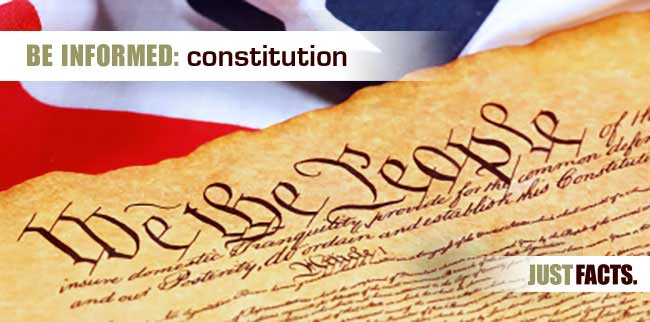
For example:

* The United States Constitution is the written pact that established the federal government and vested it with certain powers.[1] By the terms of this pact, it is “the supreme Law of the Land,” and all federal, state, and local government officials and judges are “bound by Oath or Affirmation, to support” it.[2] [3] [4]
* The U.S. Constitution is the longest-standing written constitution of all nations in the world. Many countries have copied its provisions into their constitutions.[5]
* On July 4, 1776,[6] [7] the American colonies adopted a Declaration of Independence that affirms:
* The statements above became the foundational principles of the U.S. government and its obligations to the people.[10]
* After winning this war for independence, representatives from all of the American states met in Philadelphia during 1787 to develop a Constitution that would create a new federal government and task it to protect people’s rights.[11] [12]
* Near the outset of the Constitutional Convention, Roger Sherman—a delegate from Connecticut and signatory to the Declaration of Independence—alleged that the main duties of the federal government should be to defend against foreign danger and internal uprisings, establish treaties, and tax and regulate trade with foreign nations.[13] [14]
* In response to Sherman, James Madison—who would later author the Bill of Rights and become known as the “Father of the Constitution” for his central role in its formation—stated that the items Sherman mentioned are all “important and necessary objects,” but they must be combined with “providing more effectually for the security of private rights and the steady dispensation of Justice.” He said that violations of these ideals “had more perhaps than any thing else, produced this convention.”[15] [16] [17]
* Continuing, Madison stated that all civilized societies are “divided into different sects, factions, and interests,” and “where a majority are united by a common interest or passion, the rights of the minority are in danger.” He then declared that this:
* In contrast, the Communist Manifesto calls for winning “the battle of democracy” so that a central government controls all “communication,” “property,” “transport,” “factories,” “credit,” and “agriculture.”[19]
* In essays explaining the Constitution’s protections against abuses of democracy and government power, Madison wrote:
* With the considerations above in mind, the framers of the Constitution developed a system of checks and balances on the government they formed.[25] [26] This includes:
* After the Constitution was signed by its framers on September 17, 1787, it was submitted to the individual states for ratification. Written into the Constitution is the condition that it would only be binding on the states that ratified it, and it would not become effective until at least nine of the states did so.[32] [33]
* During this ratification process, which lasted for three years,[34] there was opposition to the Constitution on several grounds, one of which was that it concentrated too much power in the hands of the federal government.[35] [36] [37]
* In an effort to build support for ratification of the Constitution,[38] three prominent statesmen collaborated in a series of essays known as the Federalist Papers, which explained the Constitution and addressed objections to it. These essays originally appeared in New York newspapers and were later assembled into book form and published throughout the states. The three authors were:
* Although the Federalist Papers were written by three individuals, all were signed with a single pen name: “Publius.” The book version of the Federalist Papers was edited by Alexander Hamilton, and the author’s name was listed as “a Citizen of New York.”[40]
* On June 21, 1788, the ninth state (New Hampshire) ratified the Constitution, thereby making it effective. By January 10, 1791, all of the existing states had ratified the Constitution.[41] That same year, the Constitution was amended to add a Bill of Rights in order to “prevent misconstruction or abuse of it powers.”[42]
* In his farewell address to the nation, George Washington, the president of the Constitutional Convention and the first president of the United States,[43] [44] said:
* Underlined Words have been altered by later amendments. Clicking on these words will bring you to the relevant amendments.
* Words in square brackets [ ] such as the clause callouts are not part of the original text of the Constitution.
* Footnotes contain links to Just Facts’ research on issues of constitutional import.
We the People of the United States, in Order to form a more perfect Union, establish Justice, insure domestic Tranquility, provide for the common defence, promote the general Welfare,[46] and secure the Blessings of Liberty to ourselves and our Posterity, do ordain and establish this Constitution for the United States of America.
All legislative Powers herein granted shall be vested in a Congress of the United States, which shall consist of a Senate and House of Representatives.
[Clause 1] The House of Representatives shall be composed of Members chosen every second Year by the People of the several States, and the Electors in each State shall have the Qualifications requisite for Electors of the most numerous Branch of the State Legislature.
[Clause 2] No Person shall be a Representative who shall not have attained to the Age of twenty five Years, and been seven Years a Citizen of the United States, and who shall not, when elected, be an Inhabitant of that State in which he shall be chosen.
[Clause 3] Representatives and direct Taxes shall be apportioned among the several States which may be included within this Union, according to their respective Numbers, which shall be determined by adding to the whole Number of free Persons, including those bound to Service for a Term of Years, and excluding Indians not taxed, three fifths of all other Persons. The actual Enumeration shall be made within three Years after the first Meeting of the Congress of the United States, and within every subsequent Term of ten Years, in such Manner as they shall by Law direct. The Number of Representatives shall not exceed one for every thirty Thousand, but each State shall have at Least one Representative; and until such enumeration shall be made, the State of New Hampshire shall be entitled to chuse three, Massachusetts eight, Rhode-Island and Providence Plantations one, Connecticut five, New-York six, New Jersey four, Pennsylvania eight, Delaware one, Maryland six, Virginia ten, North Carolina five, South Carolina five, and Georgia three.
[Clause 4] When vacancies happen in the Representation from any State, the Executive Authority thereof shall issue Writs of Election to fill such Vacancies.
[Clause 5] The House of Representatives shall chuse their Speaker and other Officers; and shall have the sole Power of Impeachment.
[Clause 1] The Senate of the United States shall be composed of two Senators from each State, chosen by the Legislature thereof, for six Years; and each Senator shall have one Vote.
[Clause 2] Immediately after they shall be assembled in Consequence of the first Election, they shall be divided as equally as may be into three Classes. The Seats of the Senators of the first Class shall be vacated at the Expiration of the second Year, of the second Class at the Expiration of the fourth Year, and of the third Class at the Expiration of the sixth Year, so that one third may be chosen every second Year; and if Vacancies happen by Resignation, or otherwise, during the Recess of the Legislature of any State, the Executive thereof may make temporary Appointments until the next Meeting of the Legislature, which shall then fill such Vacancies.
[Clause 3] No Person shall be a Senator who shall not have attained to the Age of thirty Years, and been nine Years a Citizen of the United States, and who shall not, when elected, be an Inhabitant of that State for which he shall be chosen.
[Clause 4] The Vice President of the United States shall be President of the Senate, but shall have no Vote, unless they be equally divided.
[Clause 5] The Senate shall chuse their other Officers, and also a President pro tempore, in the Absence of the Vice President, or when he shall exercise the Office of President of the United States.
[Clause 6] The Senate shall have the sole Power to try all Impeachments. When sitting for that Purpose, they shall be on Oath or Affirmation. When the President of the United States is tried, the Chief Justice shall preside: And no Person shall be convicted without the Concurrence of two thirds of the Members present.
[Clause 7] Judgment in Cases of Impeachment shall not extend further than to removal from Office, and disqualification to hold and enjoy any Office of honor, Trust or Profit under the United States: but the Party convicted shall nevertheless be liable and subject to Indictment, Trial, Judgment and Punishment, according to Law.
[Clause 1] The Times, Places and Manner of holding Elections for Senators and Representatives, shall be prescribed in each State by the Legislature thereof; but the Congress may at any time by Law make or alter such Regulations, except as to the Places of chusing Senators.
[Clause 2] The Congress shall assemble at least once in every Year, and such Meeting shall be on the first Monday in December, unless they shall by Law appoint a different Day.
[Clause 1] Each House shall be the Judge of the Elections, Returns and Qualifications of its own Members, and a Majority of each shall constitute a Quorum to do Business; but a smaller Number may adjourn from day to day, and may be authorized to compel the Attendance of absent Members, in such Manner, and under such Penalties as each House may provide.
[Clause 2] Each House may determine the Rules of its Proceedings, punish its Members for disorderly Behaviour, and, with the Concurrence of two thirds, expel a Member.
[Clause 3] Each House shall keep a Journal of its Proceedings, and from time to time publish the same, excepting such Parts as may in their Judgment require Secrecy; and the Yeas and Nays of the Members of either House on any question shall, at the Desire of one fifth of those Present, be entered on the Journal.
[Clause 4] Neither House, during the Session of Congress, shall, without the Consent of the other, adjourn for more than three days, nor to any other Place than that in which the two Houses shall be sitting.
[Clause 1] The Senators and Representatives shall receive a Compensation for their Services, to be ascertained by Law, and paid out of the Treasury of the United States. They shall in all Cases, except Treason, Felony and Breach of the Peace, be privileged from Arrest during their Attendance at the Session of their respective Houses, and in going to and returning from the same; and for any Speech or Debate in either House, they shall not be questioned in any other Place.
[Clause 2] No Senator or Representative shall, during the Time for which he was elected, be appointed to any civil Office under the Authority of the United States, which shall have been created, or the Emoluments whereof shall have been encreased during such time; and no Person holding any Office under the United States, shall be a Member of either House during his Continuance in Office.
[Clause 1] All Bills for raising Revenue shall originate in the House of Representatives; but the Senate may propose or concur with Amendments as on other Bills.
[Clause 2] Every Bill which shall have passed the House of Representatives and the Senate, shall, before it become a Law, be presented to the President of the United States; If he approve he shall sign it, but if not he shall return it, with his Objections to that House in which it shall have originated, who shall enter the Objections at large on their Journal, and proceed to reconsider it. If after such Reconsideration two thirds of that House shall agree to pass the Bill, it shall be sent, together with the Objections, to the other House, by which it shall likewise be reconsidered, and if approved by two thirds of that House, it shall become a Law. But in all such Cases the Votes of both Houses shall be determined by yeas and Nays, and the Names of the Persons voting for and against the Bill shall be entered on the Journal of each House respectively. If any Bill shall not be returned by the President within ten Days (Sundays excepted) after it shall have been presented to him, the Same shall be a Law, in like Manner as if he had signed it, unless the Congress by their Adjournment prevent its Return, in which Case it shall not be a Law.
[Clause 3] Every Order, Resolution, or Vote to which the Concurrence of the Senate and House of Representatives may be necessary (except on a question of Adjournment) shall be presented to the President of the United States; and before the Same shall take Effect, shall be approved by him, or being disapproved by him, shall be repassed by two thirds of the Senate and House of Representatives, according to the Rules and Limitations prescribed in the Case of a Bill.
[Clause 1] The Congress shall have Power To lay and collect Taxes, Duties, Imposts and Excises, to pay the Debts[47] and provide for the common Defence and general Welfare[48] of the United States; but all Duties, Imposts and Excises shall be uniform throughout the United States;
[Clause 2] To borrow Money on the credit of the United States;
[Clause 3] To regulate Commerce with foreign Nations, and among the several States, and with the Indian Tribes;
[Clause 4] To establish an uniform Rule of Naturalization, and uniform Laws on the subject of Bankruptcies throughout the United States;
[Clause 5] To coin Money, regulate the Value thereof, and of foreign Coin, and fix the Standard of Weights and Measures;
[Clause 6] To provide for the Punishment of counterfeiting the Securities and current Coin of the United States;
[Clause 7] To establish Post Offices and post Roads;
[Clause 8] To promote the Progress of Science and useful Arts, by securing for limited Times to Authors and Inventors the exclusive Right to their respective Writings and Discoveries;
[Clause 9] To constitute Tribunals inferior to the supreme Court;
[Clause 10] To define and punish Piracies and Felonies committed on the high Seas, and Offences against the Law of Nations;
[Clause 11] To declare War, grant Letters of Marque and Reprisal, and make Rules concerning Captures on Land and Water;
[Clause 12] To raise and support Armies, but no Appropriation of Money to that Use shall be for a longer Term than two Years;
[Clause 13] To provide and maintain a Navy;
[Clause 14] To make Rules for the Government and Regulation of the land and naval Forces;
[Clause 15] To provide for calling forth the Militia to execute the Laws of the Union, suppress Insurrections and repel Invasions;
[Clause 16] To provide for organizing, arming, and disciplining, the Militia, and for governing such Part of them as may be employed in the Service of the United States, reserving to the States respectively, the Appointment of the Officers, and the Authority of training the Militia according to the discipline prescribed by Congress;
[Clause 17] To exercise exclusive Legislation in all Cases whatsoever, over such District (not exceeding ten Miles square) as may, byCession of particular States, and the Acceptance of Congress, become the Seat of the Government of the United States, and to exercise like Authority over all Places purchased by the Consent of the Legislature of the State in which the Same shall be, for the Erection of Forts, Magazines, Arsenals, dock-Yards, and other needful Buildings;—And
[Clause 18] To make all Laws which shall be necessary and proper for carrying into Execution the foregoing Powers, and all other Powers vested by this Constitution in the Government of the United States, or in any Department or Officer thereof.
[Clause 1] The Migration or Importation of such Persons as any of the States now existing shall think proper to admit, shall not be prohibited by the Congress prior to the Year one thousand eight hundred and eight, but a Tax or duty may be imposed on such Importation, not exceeding ten dollars for each Person.
[Clause 2] The Privilege of the Writ of Habeas Corpus shall not be suspended, unless when in Cases of Rebellion or Invasion the public Safety may require it.
[Clause 3] No Bill of Attainder or ex post facto Law shall be passed.
[Clause 4] No Capitation, or other direct, Tax shall be laid, unless in Proportion to the Census or Enumeration herein before directed to be taken.
[Clause 5] No Tax or Duty shall be laid on Articles exported from any State.
[Clause 6] No Preference shall be given by any Regulation of Commerce or Revenue to the Ports of one State over those of another: nor shall Vessels bound to, or from, one State, be obliged to enter, clear, or pay Duties in another.
[Clause 7] No Money shall be drawn from the Treasury, but in Consequence of Appropriations made by Law; and a regular Statement and Account of the Receipts and Expenditures of all public Money shall be published from time to time.
[Clause 8] No Title of Nobility shall be granted by the United States: And no Person holding any Office of Profit or Trust under them, shall, without the Consent of the Congress, accept of any present, Emolument, Office, or Title, of any kind whatever, from any King, Prince, or foreign State.
[Clause 1] No State shall enter into any Treaty, Alliance, or Confederation; grant Letters of Marque and Reprisal; coin Money; emit Bills of Credit; make any Thing but gold and silver Coin a Tender in Payment of Debts; pass any Bill of Attainder, ex post facto Law, or Law impairing the Obligation of Contracts, or grant any Title of Nobility.
[Clause 2] No State shall, without the Consent of the Congress, lay any Imposts or Duties on Imports or Exports, except what may be absolutely necessary for executing it’s inspection Laws: and the net Produce of all Duties and Imposts, laid by any State on Imports or Exports, shall be for the Use of the Treasury of the United States; and all such Laws shall be subject to the Revision and Controul of the Congress.
[Clause 3] No State shall, without the Consent of Congress, lay any Duty of Tonnage, keep Troops, or Ships of War in time of Peace, enter into any Agreement or Compact with another State, or with a foreign Power, or engage in War, unless actually invaded, or in such imminent Danger as will not admit of delay.
[Clause 1] The executive Power shall be vested in a President of the United States of America. He shall hold his Office during the Term of four Years, and, together with the Vice President, chosen for the same Term, be elected, as follows
[Clause 2] Each State shall appoint, in such Manner as the Legislature thereof may direct, a Number of Electors, equal to the whole Number of Senators and Representatives to which the State may be entitled in the Congress: but no Senator or Representative, or Person holding an Office of Trust or Profit under the United States, shall be appointed an Elector.
[Clause 4] The Congress may determine the Time of chusing the Electors, and the Day on which they shall give their Votes; which Day shall be the same throughout the United States.
[Clause 5] No Person except a natural born Citizen, or a Citizen of the United States, at the time of the Adoption of this Constitution, shall be eligible to the Office of President; neither shall any Person be eligible to that Office who shall not have attained to the Age of thirty five Years, and been fourteen Years a Resident within the United States.
[Clause 7] The President shall, at stated Times, receive for his Services, a Compensation, which shall neither be encreased nor diminished during the Period for which he shall have been elected, and he shall not receive within that Period any other Emolument from the United States, or any of them.
[Clause 8] Before he enter on the Execution of his Office, he shall take the following Oath or Affirmation:— “I do solemnly swear (or affirm) that I will faithfully execute the Office of President of the United States, and will to the best of my Ability, preserve, protect and defend the Constitution of the United States.”
[Clause 1] The President shall be Commander in Chief of the Army and Navy of the United States, and of the Militia of the several States, when called into the actual Service of the United States; he may require the Opinion, in writing, of the principal Officer in each of the executive Departments, upon any Subject relating to the Duties of their respective Offices, and he shall have Power to grant Reprieves and Pardons for Offences against the United States, except in Cases of Impeachment.
[Clause 2] He shall have Power, by and with the Advice and Consent of the Senate, to make Treaties, provided two thirds of the Senators present concur; and he shall nominate, and by and with the Advice and Consent of the Senate, shall appoint Ambassadors, other public Ministers and Consuls, Judges of the supreme Court, and all other Officers of the United States,[49] whose Appointments are not herein otherwise provided for, and which shall be established by Law: but the Congress may by Law vest the Appointment of such inferior Officers, as they think proper, in the President alone, in the Courts of Law, or in the Heads of Departments.
[Clause 3] The President shall have Power to fill up all Vacancies that may happen during the Recess of the Senate, by granting Commissions which shall expire at the End of their next Session.
He shall from time to time give to the Congress Information of the State of the Union, and recommend to their Consideration such Measures as he shall judge necessary and expedient; he may, on extraordinary Occasions, convene both Houses, or either of them, and in Case of Disagreement between them, with Respect to the Time of Adjournment, he may adjourn them to such Time as he shall think proper; he shall receive Ambassadors and other public Ministers; he shall take Care that the Laws be faithfully executed, and shall Commission all the Officers of the United States.
The President, Vice President and all civil Officers of the United States, shall be removed from Office on Impeachment for, and Conviction of, Treason, Bribery, or other high Crimes and Misdemeanors.
The judicial Power of the United States, shall be vested in one supreme Court, and in such inferior Courts as the Congress may from time to time ordain and establish. The Judges, both of the supreme and inferior Courts, shall hold their Offices during good Behaviour, and shall, at stated Times, receive for their Services, a Compensation, which shall not be diminished during their Continuance in Office.
[Clause 1] The judicial Power shall extend to all Cases, in Law and Equity, arising under this Constitution, the Laws of the United States, and Treaties made, or which shall be made, under their Authority;—to all Cases affecting Ambassadors, other public Ministers and Consuls;—to all Cases of admiralty and maritime Jurisdiction;—to Controversies to which the United States shall be a Party;—to Controversies between two or more States;—between a State and Citizens of another State; —between Citizens of different States, —between Citizens of the same State claiming Lands under Grants of different States, and between a State, or the Citizens thereof, and foreign States, Citizens or Subjects.
[Clause 2] In all Cases affecting Ambassadors, other public Ministers and Consuls, and those in which a State shall be Party, the supreme Court shall have original Jurisdiction. In all the other Cases before mentioned, the supreme Court shall have appellate Jurisdiction, both as to Law and Fact, with such Exceptions, and under such Regulations as the Congress shall make.
[Clause 3] The Trial of all Crimes, except in Cases of Impeachment, shall be by Jury; and such Trial shall be held in the State where the said Crimes shall have been committed; but when not committed within any State, the Trial shall be at such Place or Places as the Congress may by Law have directed.
Clause 1: Treason against the United States, shall consist only in levying War against them, or in adhering to their Enemies, giving them Aid and Comfort. No Person shall be convicted of Treason unless on the Testimony of two Witnesses to the same overt Act, or on Confession in open Court.
Clause 2: The Congress shall have Power to declare the Punishment of Treason, but no Attainder of Treason shall work Corruption of Blood, or Forfeiture except during the Life of the Person attainted.
Full Faith and Credit shall be given in each State to the public Acts, Records, and judicial Proceedings of every other State. And the Congress may by general Laws prescribe the Manner in which such Acts, Records and Proceedings shall be proved, and the Effect thereof.
[Clause 1] The Citizens of each State shall be entitled to all Privileges and Immunities of Citizens in the several States.
[Clause 2] A Person charged in any State with Treason, Felony, or other Crime, who shall flee from Justice, and be found in another State, shall on Demand of the executive Authority of the State from which he fled, be delivered up, to be removed to the State having Jurisdiction of the Crime.
[Clause 1] New States may be admitted by the Congress into this Union; but no new State shall be formed or erected within the Jurisdiction of any other State; nor any State be formed by the Junction of two or more States, or Parts of States, without the Consent of the Legislatures of the States concerned as well as of the Congress.
[Clause 2] The Congress shall have Power to dispose of and make all needful Rules and Regulations respecting the Territory or other Property belonging to the United States; and nothing in this Constitution shall be so construed as to Prejudice any Claims of the United States, or of any particular State.
The United States shall guarantee to every State in this Union a Republican Form of Government, and shall protect each of them against Invasion; and on Application of the Legislature, or of the Executive (when the Legislature cannot be convened) against domestic Violence.
The Congress, whenever two thirds of both Houses shall deem it necessary, shall propose Amendments to this Constitution, or, on the Application of the Legislatures of two thirds of the several States, shall call a Convention for proposing Amendments, which, in either Case, shall be valid to all Intents and Purposes, as Part of this Constitution, when ratified by the Legislatures of three fourths of the several States, or by Conventions in three fourths thereof, as the one or the other Mode of Ratification may be proposed by the Congress; Provided that no Amendment which may be made prior to the Year One thousand eight hundred and eight shall in any Manner affect the first and fourth Clauses in the Ninth Section of the first Article; and that no State, without its Consent, shall be deprived of its equal Suffrage in the Senate.
[Clause 1] All Debts contracted and Engagements entered into, before the Adoption of this Constitution, shall be as valid against the United States under this Constitution, as under the Confederation.
[Clause 2] This Constitution, and the Laws of the United States which shall be made in Pursuance thereof; and all Treaties made, or which shall be made, under the Authority of the United States, shall be the supreme Law of the Land; and the Judges in every State shall be bound thereby, any Thing in the Constitution or Laws of any State to the Contrary notwithstanding.
[Clause 3] The Senators and Representatives before mentioned, and the Members of the several State Legislatures, and all executive and judicial Officers, both of the United States and of the several States, shall be bound by Oath or Affirmation, to support this Constitution; but no religious Test shall ever be required as a Qualification to any Office or public Trust under the United States.
The Ratification of the Conventions of nine States, shall be sufficient for the establishment of this Constitution between the States so ratifying the Same.
done in Convention by the Unanimous Consent of the States present the Seventeenth Day of September in the Year of our Lord one thousand seven hundred and Eighty seven and of the Independence of the United States of America the Twelfth In witness whereof We have hereunto subscribed our Names,
GO WASHINGTON—Presidt. and deputy from Virginia
Delaware
Geo: Read
Gunning Bedford jun
John Dickinson
Richard Bassett
Jaco: Broom
Maryland
James MCHenry
Dan of ST ThoS. Jenifer
DanL Carroll.
Virginia
John Blair—
James Madison Jr.
North Carolina
WM Blount
RichD. Dobbs Spaight.
Hu Williamson
South Carolina
J. Rutledge
Charles 1ACotesworth Pinckney
Charles Pinckney
Pierce Butler.
Georgia
William Few
Abr Baldwin
New Hampshire
John Langdon
Nicholas Gilman
Massachusetts
Nathaniel Gorham
Rufus King
Connecticut
WM. SamL. Johnson
Roger Sherman
New York
Alexander Hamilton
New Jersey
Wil: Livingston
David Brearley.
WM. Paterson.
Jona: Dayton
Pennsylvania
B Franklin
Thomas Mifflin
RobT Morris
Geo. Clymer
ThoS. FitzSimons
Jared Ingersoll
James Wilson.
Gouv Morris
Attest William Jackson Secretary
* In 1791, the U.S. government enacted 10 amendments to the Constitution known as the “Bill of Rights.” The preamble to these rights states:
* In the 1833 case of Barron v Baltimore, the U.S. Supreme Court ruled that the rights of the people in the Constitution and the Bill of Rights only had to be respected by the federal government and could be infringed by state governments.[51]
* In the 1857 case of Dred Scott v. Sandford, the U.S. Supreme Court ruled (7–2) that black people were not “people of the United States” and “were not intended to be included, under the word ‘citizens’ in the Constitution, and can therefore claim none of the rights and privileges which that instrument provides for and secures to citizens of the United States.”[52]
* In 1866—one year after the Civil War ended and slavery was banned by the 13th Amendment—a bloc of Congressmen called the “Radical Republicans” passed a law to protect the “constitutional rights” of “all persons” without regard to their “race or color, or previous condition of slavery or involuntary servitude….”[53] [54] [55] [56]
* To guarantee that this 1866 law was constitutional, the Radical Republicans fought for and secured passage of the 14th Amendment in 1868.[57] [58] It reads in part:
* Republican Senator Jacob Howard of Michigan served on the committee that drafted the 14th Amendment, and he introduced it during a speech on the floor of the Senate. In this speech, he stated that its primary purpose is “to restrain the power of the States and compel them at all times to respect” the “personal rights guaranteed and secured by the first eight amendments of the Constitution,” including:
* Seven years after the passage of the 14th Amendment, the U.S. Supreme Court ruled (5 to 4) in an 1875 case called United States v. Cruikshank that the U.S. Constitution:
* The Supreme Court’s ruling in Cruikshank allowed white militias and mobs to subjugate black people through violence and intimidation.[64]
* Since Cruikshank, the U.S. Supreme Court has issued various decisions that require state governments to respect most of the rights in the Bill of Rights but not all of them. Under these rulings, states must honor only those rights that the Supreme Court deems to be “fundamental” to the American “scheme of ordered liberty.”[65]
The text of the 10 amendments below is from the official transcript of the Bill of Rights in the National Archives, which states: “The capitalization and punctuation in this version is from the enrolled original of the Joint Resolution of Congress proposing the Bill of Rights, which is on permanent display in the Rotunda of the National Archives Building, Washington, D.C.”
Ratified December 15, 1791
Congress shall make no law respecting an establishment of religion, or prohibiting the free exercise thereof; or abridging the freedom of speech, or of the press; or the right of the people peaceably to assemble, and to petition the Government for a redress of grievances.
NOTE: For comprehensive facts about First Amendment and:
Ratified December 15, 1791
A well regulated Militia, being necessary to the security of a free State, the right of the people to keep and bear Arms shall not be infringed.
NOTE: For comprehensive facts about the Second Amendment, visit Just Facts’ research on gun control.
Ratified December 15, 1791
No Soldier shall, in time of peace be quartered in any house, without the consent of the Owner, nor in time of war, but in a manner to be prescribed by law.
Ratified December 15, 1791
The right of the people to be secure in their persons, houses, papers, and effects, against unreasonable searches and seizures, shall not be violated, and no Warrants shall issue, but upon probable cause, supported by Oath or affirmation, and particularly describing the place to be searched, and the persons or things to be seized.
Ratified December 15, 1791
No person shall be held to answer for a capital, or otherwise infamous crime, unless on a presentment or indictment of a Grand Jury, except in cases arising in the land or naval forces, or in the Militia, when in actual service in time of War or public danger; nor shall any person be subject for the same offence to be twice put in jeopardy of life or limb; nor shall be compelled in any criminal case to be a witness against himself, nor be deprived of life, liberty, or property, without due process of law; nor shall private property be taken for public use, without just compensation.
NOTE: For comprehensive facts about the Fifth Amendment and the rights to life and liberty as they apply to the issue of abortion, visit Just Facts’ research on the constitutional aspects of abortion.
Ratified December 15, 1791
In all criminal prosecutions, the accused shall enjoy the right to a speedy and public trial, by an impartial jury of the State and district wherein the crime shall have been committed, which district shall have been previously ascertained by law, and to be informed of the nature and cause of the accusation; to be confronted with the witnesses against him; to have compulsory process for obtaining witnesses in his favor, and to have the Assistance of Counsel for his defence.
Ratified December 15, 1791
In Suits at common law, where the value in controversy shall exceed twenty dollars, the right of trial by jury shall be preserved, and no fact tried by a jury, shall be otherwise re-examined in any Court of the United States, than according to the rules of the common law.
Ratified December 15, 1791
Excessive bail shall not be required, nor excessive fines imposed, nor cruel and unusual punishments inflicted.
Ratified December 15, 1791
The enumeration in the Constitution, of certain rights, shall not be construed to deny or disparage others retained by the people.
Ratified December 15, 1791
The powers not delegated to the United States by the Constitution, nor prohibited by it to the States, are reserved to the States respectively, or to the people.
Ratified February 7, 1795
The Judicial power of the United States shall not be construed to extend to any suit in law or equity, commenced or prosecuted against one of the United States by Citizens of another State, or by Citizens or Subjects of any Foreign State.
Ratified June 15, 1804
The Electors shall meet in their respective states, and vote by ballot for President and Vice-President, one of whom, at least, shall not be an inhabitant of the same state with themselves; they shall name in their ballots the person voted for as President, and in distinct ballots the person voted for as Vice-President, and they shall make distinct lists of all persons voted for as President, and of all persons voted for as Vice-President, and of the number of votes for each, which lists they shall sign and certify, and transmit sealed to the seat of the government of the United States, directed to the President of the Senate;—The President of the Senate shall, in the presence of the Senate and House of Representatives, open all the certificates and the votes shall then be counted;—The person having the greatest number of votes for President, shall be the President, if such number be a majority of the whole number of Electors appointed; and if no person have such majority, then from the persons having the highest numbers not exceeding three on the list of those voted for as President, the House of Representatives shall choose immediately, by ballot, the President. But in choosing the President, the votes shall be taken by states, the representation from each state having one vote; a quorum for this purpose shall consist of a member or members from two-thirds of the states, and a majority of all the states shall be necessary to a choice. And if the House of Representatives shall not choose a President whenever the right of choice shall devolve upon them, before the fourth day of March next following, then the Vice-President shall act as President, as in the case of the death or other constitutional disability of the President. —The person having the greatest number of votes as Vice-President, shall be the Vice-President, if such number be a majority of the whole number of Electors appointed, and if no person have a majority, then from the two highest numbers on the list, the Senate shall choose the Vice-President; a quorum for the purpose shall consist of two-thirds of the whole number of Senators, and a majority of the whole number shall be necessary to a choice. But no person constitutionally ineligible to the office of President shall be eligible to that of Vice-President of the United States.
Ratified December 6, 1865
Section 1. Neither slavery nor involuntary servitude, except as a punishment for crime whereof the party shall have been duly convicted, shall exist within the United States, or any place subject to their jurisdiction.
Section 2. Congress shall have power to enforce this article by appropriate legislation.
NOTE: For comprehensive facts about the history of slavery in the United States, visit Just Facts’ research on racial issues.
Ratified July 9, 1868
Section 1. All persons born or naturalized in the United States, and subject to the jurisdiction thereof, are citizens of the United States and of the State wherein they reside. No State shall make or enforce any law which shall abridge the privileges or immunities of citizens of the United States; nor shall any State deprive any person of life, liberty, or property, without due process of law; nor deny to any person within its jurisdiction the equal protection of the laws.
Section 2. Representatives shall be apportioned among the several States according to their respective numbers, counting the whole number of persons in each State, excluding Indians not taxed. But when the right to vote at any election for the choice of electors for President and Vice President of the United States, Representatives in Congress, the Executive and Judicial officers of a State, or the members of the Legislature thereof, is denied to any of the male inhabitants of such State, being twenty-one years of age, and citizens of the United States, or in any way abridged, except for participation in rebellion, or other crime, the basis of representation therein shall be reduced in the proportion which the number of such male citizens shall bear to the whole number of male citizens twenty-one years of age in such State.
Section 3. No person shall be a Senator or Representative in Congress, or elector of President and Vice President, or hold any office, civil or military, under the United States, or under any State, who, having previously taken an oath, as a member of Congress, or as an officer of the United States, or as a member of any State legislature, or as an executive or judicial officer of any State, to support the Constitution of the United States, shall have engaged in insurrection or rebellion against the same, or given aid or comfort to the enemies thereof. But Congress may by a vote of two-thirds of each House, remove such disability.
Section 4. The validity of the public debt of the United States, authorized by law, including debts incurred for payment of pensions and bounties for services in suppressing insurrection or rebellion, shall not be questioned. But neither the United States nor any State shall assume or pay any debt or obligation incurred in aid of insurrection or rebellion against the United States, or any claim for the loss or emancipation of any slave; but all such debts, obligations and claims shall be held illegal and void.
Section 5. The Congress shall have power to enforce, by appropriate legislation, the provisions of this article.
NOTE: For comprehensive facts about the 14th Amendment and:
Ratified February 3, 1870
Section 1. The right of citizens of the United States to vote shall not be denied or abridged by the United States or by any State on account of race, color, or previous condition of servitude.
Section 2. The Congress shall have power to enforce this article by appropriate legislation.
NOTE: For comprehensive facts about the voting rights of African Americans, visit Just Facts’ research on civil rights.
Ratified February 3, 1913
The Congress shall have power to lay and collect taxes on incomes, from whatever source derived, without apportionment among the several States, and without regard to any census or enumeration.
Ratified April 8, 1913
The Senate of the United States shall be composed of two Senators from each State, elected by the people thereof, for six years; and each Senator shall have one vote. The electors in each State shall have the qualifications requisite for electors of the most numerous branch of the State legislatures.
When vacancies happen in the representation of any State in the Senate, the executive authority of such State shall issue writs of election to fill such vacancies: Provided, That the legislature of any State may empower the executive thereof to make temporary appointments until the people fill the vacancies by election as the legislature may direct.
This amendment shall not be so construed as to affect the election or term of any Senator chosen before it becomes valid as part of the Constitution.
Ratified January 16, 1919
Section 1. After one year from the ratification of this article the manufacture, sale, or transportation of intoxicating liquors within, the importation thereof into, or the exportation thereof from the United States and all territory subject to the jurisdiction thereof for beverage purposes is hereby prohibited.
Section. 2. The Congress and the several States shall have concurrent power to enforce this article by appropriate legislation.
Section. 3. This article shall be inoperative unless it shall have been ratified as an amendment to the Constitution by the legislatures of the several States, as provided in the Constitution, within seven years from the date of the submission hereof to the States by the Congress.
Ratified August 18, 1920
The right of citizens of the United States to vote shall not be denied or abridged by the United States or by any State on account of sex.
Congress shall have power to enforce this article by appropriate legislation.
Ratified January 23, 1933
Section 1. The terms of the President and Vice President shall end at noon on the 20th day of January, and the terms of Senators and Representatives at noon on the 3d day of January, of the years in which such terms would have ended if this article had not been ratified; and the terms of their successors shall then begin.
Section. 2. The Congress shall assemble at least once in every year, and such meeting shall begin at noon on the 3d day of January, unless they shall by law appoint a different day.
Section. 3. If, at the time fixed for the beginning of the term of the President, the President elect shall have died, the Vice President elect shall become President. If a President shall not have been chosen before the time fixed for the beginning of his term, or if the President elect shall have failed to qualify, then the Vice President elect shall act as President until a President shall have qualified; and the Congress may by law provide for the case wherein neither a President elect nor a Vice President elect shall have qualified, declaring who shall then act as President, or the manner in which one who is to act shall be selected, and such person shall act accordingly until a President or Vice President shall have qualified.
Section. 4. The Congress may by law provide for the case of the death of any of the persons from whom the House of Representatives may choose a President whenever the right of choice shall have devolved upon them, and for the case of the death of any of the persons from whom the Senate may choose a Vice President whenever the right of choice shall have devolved upon them.
Section. 5. Sections 1 and 2 shall take effect on the 15th day of October following the ratification of this article.
Section. 6. This article shall be inoperative unless it shall have been ratified as an amendment to the Constitution by the legislatures of three-fourths of the several States within seven years from the date of its submission.
Ratified December 5, 1933
Section 1. The eighteenth article of amendment to the Constitution of the United States is hereby repealed.
Section 2. The transportation or importation into any State, Territory, or possession of the United States for delivery or use therein of intoxicating liquors, in violation of the laws thereof, is hereby prohibited.
Section 3. This article shall be inoperative unless it shall have been ratified as an amendment to the Constitution by conventions in the several States, as provided in the Constitution, within seven years from the date of the submission hereof to the States by the Congress.
Ratified February 27, 1951
Section 1. No person shall be elected to the office of the President more than twice, and no person who has held the office of President, or acted as President, for more than two years of a term to which some other person was elected President shall be elected to the office of the President more than once. But this article shall not apply to any person holding the office of President when this article was proposed by the Congress, and shall not prevent any person who may be holding the office of President, or acting as President, during the term within which this article becomes operative from holding the office of President or acting as President during the remainder of such term.
Section 2. This article shall be inoperative unless it shall have been ratified as an amendment to the Constitution by the legislatures of three-fourths of the several states within seven years from the date of its submission to the states by the Congress.
Ratified March 29, 1961
Section 1. The District constituting the seat of government of the United States shall appoint in such manner as the Congress may direct:
A number of electors of President and Vice President equal to the whole number of Senators and Representatives in Congress to which the District would be entitled if it were a state, but in no event more than the least populous state; they shall be in addition to those appointed by the states, but they shall be considered, for the purposes of the election of President and Vice President, to be electors appointed by a state; and they shall meet in the District and perform such duties as provided by the twelfth article of amendment.
Section 2. The Congress shall have power to enforce this article by appropriate legislation.
Ratified January 23, 1964
Section 1. The right of citizens of the United States to vote in any primary or other election for President or Vice President, for electors for President or Vice President, or for Senator or Representative in Congress, shall not be denied or abridged by the United States or any state by reason of failure to pay any poll tax or other tax.
Section 2. The Congress shall have power to enforce this article by appropriate legislation.
NOTE: For comprehensive facts about the voting rights of African Americans, visit Just Facts’ research on civil rights.
Ratified February 10, 1967
Section 1. In case of the removal of the President from office or of his death or resignation, the Vice President shall become President.
Section 2. Whenever there is a vacancy in the office of the Vice President, the President shall nominate a Vice President who shall take office upon confirmation by a majority vote of both Houses of Congress.
Section 3. Whenever the President transmits to the President pro tempore of the Senate and the Speaker of the House of Representatives his written declaration that he is unable to discharge the powers and duties of his office, and until he transmits to them a written declaration to the contrary, such powers and duties shall be discharged by the Vice President as Acting President.
Section 4. Whenever the Vice President and a majority of either the principal officers of the executive departments or of such other body as Congress may by law provide, transmit to the President pro tempore of the Senate and the Speaker of the House of Representatives their written declaration that the President is unable to discharge the powers and duties of his office, the Vice President shall immediately assume the powers and duties of the office as Acting President.
Thereafter, when the President transmits to the President pro tempore of the Senate and the Speaker of the House of Representatives his written declaration that no inability exists, he shall resume the powers and duties of his office unless the Vice President and a majority of either the principal officers of the executive department or of such other body as Congress may by law provide, transmit within four days to the President pro tempore of the Senate and the Speaker of the House of Representatives their written declaration that the President is unable to discharge the powers and duties of his office. Thereupon Congress shall decide the issue, assembling within forty-eight hours for that purpose if not in session. If the Congress, within twenty-one days after receipt of the latter written declaration, or, if Congress is not in session, within twenty-one days after Congress is required to assemble, determines by two-thirds vote of both Houses that the President is unable to discharge the powers and duties of his office, the Vice President shall continue to discharge the same as Acting President; otherwise, the President shall resume the powers and duties of his office.
Ratified July 1, 1971
Section 1. The right of citizens of the United States, who are 18 years of age or older, to vote, shall not be denied or abridged by the United States or any state on account of age.
Section 2. The Congress shall have the power to enforce this article by appropriate legislation.
Ratified May 7, 1992
No law varying the compensation for the services of the Senators and Representatives shall take effect until an election of Representatives shall have intervened.
[1] The Federalist Papers. By Alexander Hamilton, John Jay, and James Madison. October 27, 1787–May 28, 1788. <www.gutenberg.org>
Federalist Paper 1. By Alexander Hamilton, October 27, 1787:
After an unequivocal experience of the inefficiency of the subsisting federal government, you are called upon to deliberate on a new Constitution for the United States of America. The subject speaks its own importance; comprehending in its consequences nothing less than the existence of the Union, the safety and welfare of the parts of which it is composed, the fate of an empire in many respects the most interesting in the world. It has been frequently remarked that it seems to have been reserved to the people of this country, by their conduct and example, to decide the important question, whether societies of men are really capable or not of establishing good government from reflection and choice, or whether they are forever destined to depend for their political constitutions on accident and force.
Federalist Paper 2. By John Jay, October 31, 1787:
Nothing is more certain than the indispensable necessity of government, and it is equally undeniable, that whenever and however it is instituted, the people must cede to it some of their natural rights in order to vest it with requisite powers. It is well worthy of consideration therefore, whether it would conduce more to the interest of the people of America that they should, to all general purposes, be one nation, under one federal government, or that they should divide themselves into separate confederacies, and give to the head of each the same kind of powers which they are advised to place in one national government. …
A strong sense of the value and blessings of union induced the people, at a very early period, to institute a federal government to preserve and perpetuate it. They formed it almost as soon as they had a political existence; nay, at a time when their habitations were in flames, when many of their citizens were bleeding, and when the progress of hostility and desolation left little room for those calm and mature inquiries and reflections which must ever precede the formation of a wise and well-balanced government for a free people. It is not to be wondered at, that a government instituted in times so inauspicious, should on experiment be found greatly deficient and inadequate to the purpose it was intended to answer.
This intelligent people perceived and regretted these defects. Still continuing no less attached to union than enamored of liberty, they observed the danger which immediately threatened the former and more remotely the latter; and being persuaded that ample security for both could only be found in a national government more wisely framed, they as with one voice, convened the late convention at Philadelphia, to take that important subject under consideration.
This convention composed of men who possessed the confidence of the people, and many of whom had become highly distinguished by their patriotism, virtue and wisdom, in times which tried the minds and hearts of men, undertook the arduous task. In the mild season of peace, with minds unoccupied by other subjects, they passed many months in cool, uninterrupted, and daily consultation; and finally, without having been awed by power, or influenced by any passions except love for their country, they presented and recommended to the people the plan produced by their joint and very unanimous councils.
[2] Constitution of the United States. Signed September 17, 1787. <justfacts.com>
Article VI, Clause 2:
This Constitution, and the Laws of the United States which shall be made in Pursuance thereof; and all Treaties made, or which shall be made, under the Authority of the United States, shall be the supreme Law of the Land; and the Judges in every State shall be bound thereby, any Thing in the Constitution or Laws of any State to the Contrary notwithstanding.
Article VI, Clause 3:
The Senators and Representatives before mentioned, and the Members of the several State Legislatures, and all executive and judicial Officers, both of the United States and of the several States, shall be bound by Oath or Affirmation, to support this Constitution; but no religious Test shall ever be required as a Qualification to any Office or public Trust under the United States.
Article II, Section 1, Clause 8:
Before he enter on the Execution of his Office, [the President] shall take the following Oath or Affirmation … “I do solemnly swear (or affirm) that I will faithfully execute the Office of President of the United States, and will to the best of my Ability, preserve, protect and defend Constitution of the United States.
[3] Book: Managing Local Government: An Essential Guide for Municipal and County Managers. By Kimberly L. Nelson and Carl W. Stenberg. CQ Press, 2017.
Page 36:
In contrast to the federal system that exists between the federal government and the states, the relationship between states and the local governments is a unitary system. Instead of a system of shared authority, power is held by the state. As articulated in the quote at the beginning of the chapter, local governments derive their authority from their states. Local governments have no independent authority unless the state grants it to them.
[4] Ruling: Reid v. Covert. U.S. Supreme Court, June 11, 1956. Decided 6–2. Majority: Black, Warren, Douglas, Brennan. Concurring: Frankfurter. Concurring: Harlan. Dissent: Clark, Burton. <caselaw.findlaw.com>
Majority:
The obvious and decisive answer to this, of course, is that no agreement with a foreign nation can confer power on the Congress, or on any other branch of Government, which is free from the restraints of the Constitution.
Article VI, the Supremacy Clause of the Constitution, declares:
This Constitution, and the Laws of the United States which shall be made in Pursuance thereof, and all Treaties made, or which shall be made, under the Authority of the United States, shall be the supreme Law of the Land; …
There is nothing in this language which intimates that treaties and laws enacted pursuant to them do not have to comply with the provisions of the Constitution. Nor is there anything in the debates which accompanied the drafting and ratification of the Constitution which even suggests such a result. These debates, as well as the history that surrounds the adoption of the treaty provision in Article VI, make it clear that the reason treaties were not limited to those made in “pursuance” of the Constitution was so that agreements made by the United States under the Articles of Confederation, including the important peace treaties which concluded the Revolutionary War, would remain in effect.31
It would be manifestly contrary to the objectives of those who created the Constitution, as well as those who were responsible for the Bill of Rights—let alone alien to our entire constitutional history and tradition—to construe Article VI as permitting the United States to exercise power under an international agreement without observing constitutional prohibitions.32 In effect, such construction would permit amendment of that document in a manner not sanctioned by Article V. The prohibitions of the Constitution were designed to apply to all branches of the National Government, and they cannot be nullified by the Executive or by the Executive and the Senate combined. …
This Court has also repeatedly taken the position that an Act of Congress, which must comply with the Constitution, is on a full parity with a treaty, and that, when a statute which is subsequent in time is inconsistent with a treaty, the statute to the extent of conflict renders the treaty null.34 It would be completely anomalous to say that a treaty need not comply with the Constitution when such an agreement can be overridden by a statute that must conform to that instrument.
[5] Article: “Constitution of the United States of America.” Encyclopædia Britannica. Last updated October 26, 2018. <www.britannica.com>
The oldest written national constitution in use, the Constitution defines the principal organs of government and their jurisdictions and the basic rights of citizens. …
In more than two centuries of operation, the United States Constitution has proved itself a dynamic document. It has served as a model for other countries, its provisions being widely imitated in national constitutions throughout the world.
[6] Webpage: “The Declaration of Independence: How Did it Happen?” U.S. National Archives. Accessed July 4, 2023 at <www.archives.gov>
“On July 2, 1776, Congress voted to declare independence. Two days later, it ratified the text of the Declaration.”
[7] Webpage: “Declaration of Independence.” U.S. Library of Congress. Accessed July 4, 2023 at <www.loc.gov>
“On July 4, 1776, the Second Continental Congress, meeting in Philadelphia in the Pennsylvania State House (now Independence Hall), approved the Declaration of Independence, severing the colonies’ ties to the British Crown.”
[8] Article: “Continental Congress.” Encyclopædia Britannica Ultimate Reference Suite 2004.
(1774–89), in the period of the American Revolution, the body of delegates who spoke and acted collectively for the people of the colony-states that later became the United States of America. The term most specifically refers to the bodies that met in 1774 and 1775–81 and respectively designated as the First Continental Congress and the Second Continental Congress.
In the spring of 1774, the British Parliament’s passage of the Intolerable (Coercive) Acts, including the closing of the port of Boston, provoked keen resentment in the colonies. The First Continental Congress, convened in response to the Acts by the colonial Committees of Correspondence, met in Philadelphia on September 5, 1774. Fifty-six deputies represented all the colonies except Georgia. …
… Meeting in secret session, the body rejected a plan for reconciling British authority with colonial freedom. Instead, it adopted a declaration of personal rights, including life, liberty, property, assembly, and trial by jury. The declaration also denounced taxation without representation and the maintenance of the British army in the colonies without their consent. Parliamentary regulation of American commerce, however, was willingly accepted. …
Before that Second Continental Congress assembled in the Pennsylvania State House, hostilities had already broken out between Americans and British troops at Lexington and Concord, Massachusetts.
[9] Declaration of Independence. Second Continental Congress, July 4, 1776. <www.archives.gov>
When in the Course of human events, it becomes necessary for one people to dissolve the political bands which have connected them with another, and to assume among the powers of the earth, the separate and equal station to which the Laws of Nature and of Nature’s God entitle them, a decent respect to the opinions of mankind requires that they should declare the causes which impel them to the separation.
We hold these truths to be self-evident, that all men are created equal, that they are endowed by their Creator with certain unalienable Rights, that among these are Life, Liberty and the pursuit of Happiness. That to secure these rights, Governments are instituted among Men, deriving their just powers from the consent of the governed,—That whenever any Form of Government becomes destructive of these ends, it is the Right of the People to alter or to abolish it, and to institute new Government, laying its foundation on such principles and organizing its powers in such form, as to them shall seem most likely to effect their Safety and Happiness. …
We, therefore, the Representatives of the united States of America, in General Congress, Assembled, appealing to the Supreme Judge of the world for the rectitude of our intentions, do, in the Name, and by Authority of the good People of these Colonies, solemnly publish and declare, That these United Colonies are, and of Right ought to be Free and Independent States; that they are Absolved from all Allegiance to the British Crown, and that all political connection between them and the State of Great Britain, is and ought to be totally dissolved; and that as Free and Independent States, they have full Power to levy War, conclude Peace, contract Alliances, establish Commerce, and to do all other Acts and Things which Independent States may of right do. And for the support of this Declaration, with a firm reliance on the protection of divine Providence, we mutually pledge to each other our Lives, our Fortunes and our sacred Honor.
[10] Ruling: Gulf v. Ellis. U.S. Supreme Court, January 18, 1897. Decided 5–3. <caselaw.findlaw.com>
The first official action of this nation declared the foundation of government in these words: “We hold these truths to be self-evident that all men are created equal, that they are endowed by their Creator with certain unalienable rights, that among these are life, liberty, and the pursuit of happiness.” While such declaration of principles may not have the force of organic law, or be made the basis of judicial decision as to the limits of right and duty, and while in all cases reference must be had to the organic law of the nation for such limits, yet the latter is but the body and the letter of which the former is the thought and the spirit, and it is always safe to read the letter of the constitution in the spirit of the Declaration of Independence. No duty rests more imperatively upon the courts than the enforcement of those constitutional provisions intended to secure that equality of rights which is the foundation of free government.
[11] The Federalist Papers. By Alexander Hamilton, John Jay, and James Madison. October 27, 1787–May 28, 1788. <www.gutenberg.org>
Federalist Paper 1. By Alexander Hamilton, October 27, 1787:
After an unequivocal experience of the inefficiency of the subsisting federal government, you are called upon to deliberate on a new Constitution for the United States of America. The subject speaks its own importance; comprehending in its consequences nothing less than the existence of the Union, the safety and welfare of the parts of which it is composed, the fate of an empire in many respects the most interesting in the world. It has been frequently remarked that it seems to have been reserved to the people of this country, by their conduct and example, to decide the important question, whether societies of men are really capable or not of establishing good government from reflection and choice, or whether they are forever destined to depend for their political constitutions on accident and force.
Federalist Paper 2. By John Jay, October 31, 1787:
Nothing is more certain than the indispensable necessity of government, and it is equally undeniable, that whenever and however it is instituted, the people must cede to it some of their natural rights in order to vest it with requisite powers. It is well worthy of consideration therefore, whether it would conduce more to the interest of the people of America that they should, to all general purposes, be one nation, under one federal government, or that they should divide themselves into separate confederacies, and give to the head of each the same kind of powers which they are advised to place in one national government. …
A strong sense of the value and blessings of union induced the people, at a very early period, to institute a federal government to preserve and perpetuate it. They formed it almost as soon as they had a political existence; nay, at a time when their habitations were in flames, when many of their citizens were bleeding, and when the progress of hostility and desolation left little room for those calm and mature inquiries and reflections which must ever precede the formation of a wise and well-balanced government for a free people. It is not to be wondered at, that a government instituted in times so inauspicious, should on experiment be found greatly deficient and inadequate to the purpose it was intended to answer.
This intelligent people perceived and regretted these defects. Still continuing no less attached to union than enamored of liberty, they observed the danger which immediately threatened the former and more remotely the latter; and being persuaded that ample security for both could only be found in a national government more wisely framed, they as with one voice, convened the late convention at Philadelphia, to take that important subject under consideration.
This convention composed of men who possessed the confidence of the people, and many of whom had become highly distinguished by their patriotism, virtue and wisdom, in times which tried the minds and hearts of men, undertook the arduous task. In the mild season of peace, with minds unoccupied by other subjects, they passed many months in cool, uninterrupted, and daily consultation; and finally, without having been awed by power, or influenced by any passions except love for their country, they presented and recommended to the people the plan produced by their joint and very unanimous councils.
[12] Book: The Debates in the Federal Convention of 1787, Which Framed the Constitution of the United States of America, Reported by James Madison, a Delegate From the State of Virginia. Edited by Gaillard Hund and James Brown Scott. Oxford University Press, 1920. <avalon.law.yale.edu>
June 6, 1787:
Mr. [Roger] Sherman … The objects of the Union, he thought were few. 1. defence agst. foreign danger. 2. agst. internal disputes & a resort to force. 3. Treaties with foreign nations. 4. regulating foreign commerce, & drawing revenue from it. These & perhaps a few lesser objects alone rendered a Confederation of the States necessary. All other matters civil & criminal would be much better in the hands of the States. The people are more happy in small than large States. States may indeed be too small as Rhode Island, & thereby be too subject to faction. Some others were perhaps too large, the powers of Govt. not being able to pervade them. He was for giving the General Govt. power to legislate and execute within a defined province. …
Mr. [James] Madison … differed from the member from Connecticut [Mr. Sherman] in thinking the objects mentioned to be all the principal ones that required a National Govt. Those were certainly important and necessary objects; but he combined with them the necessity of providing more effectually for the security of private rights, and the steady dispensation of Justice. Interferences with these were evils which had more perhaps than any thing else, produced this convention. …
The lesson we are to draw from the whole is that where a majority are united by a common sentiment, and have an opportunity, the rights of the minor party become insecure. In a Republican Govt. the Majority if united have always an opportunity. The only remedy is to enlarge the sphere, & thereby divide the community into so great a number of interests & parties, that in the 1st. place a majority will not be likely at the same moment to have a common interest separate from that of the whole or of the minority; and in the 2d. place, that in case they shd. have such an interest, they may not be apt to unite in the pursuit of it. It was incumbent on us then to try this remedy, and with that view to frame a republican system on such a scale & in such a form as will controul all the evils wch. have been experienced.
[13] Article: “Sherman, Roger.” Contributor: Jere Daniell (Ph.D., Former Professor of History, Dartmouth College). World Book Encyclopedia, 2007 Deluxe Edition.
[T]he only person who signed all four of these great documents: the Articles of Association (1774), the Declaration of Independence (1776), the Articles of Confederation (1777), and the Constitution of the United States (1787). …
During the Constitutional Convention of 1787, Sherman presented the Great Compromise, sometimes called the Connecticut Compromise. It resolved the differences between the large and small states on representation in the national legislature.
[14] The Debates in the Federal Convention of 1787, Which Framed the Constitution of the United States of America, Reported by James Madison, a Delegate From the State of Virginia. Edited by Gaillard Hund and James Brown Scott. Oxford University Press, 1920. <avalon.law.yale.edu>
June 6, 1787:
Mr. [Roger] Sherman … The objects of the Union, he thought were few. 1. defence agst. foreign danger. 2. agst. internal disputes & a resort to force. 3. Treaties with foreign nations. 4. regulating foreign commerce, & drawing revenue from it. These & perhaps a few lesser objects alone rendered a Confederation of the States necessary. All other matters civil & criminal would be much better in the hands of the States. The people are more happy in small than large States. States may indeed be too small as Rhode Island, & thereby be too subject to faction. Some others were perhaps too large, the powers of Govt. not being able to pervade them. He was for giving the General Govt. power to legislate and execute within a defined province.
[15] Book: The Bill of Rights and the States: The Colonial and Revolutionary Origins of American Liberties. Edited by Patrick T. Conley & John P. Kaminski. Madison House Publishers, 1992. Pages 461-514: “The Bill of Rights: A Bibliographic Essay.” By Gaspare J. Saladino.
Page 484:
The best historical treatments of the legislative history of the Bill of Rights in the first federal Congress are in the general accounts by Rutland, Dumbauld, Brant, Schwartz, and Levy, and in David M. Matteson, The Organization of the Government under the Constitution (1941; reprint ed., New York, 1970). All agree that James Madison, against considerable odds, took the lead in the House of Representatives, and that without his efforts there probably would have been no Bill of Rights. Madison’s amendments, a distillation of those from the state conventions (especially Virginia’s) were, for the most part, those that the House eventually adopted.
[16] Article: “Madison, James.” Contributor: Robert J. Brugger (Ph.D., Editor, Maryland Historical Magazine, Maryland Historical Society). World Book Encyclopedia, 2007 Deluxe Edition.
[O]ften called the Father of the Constitution. He played a leading role in the Constitutional Convention of 1787, where he helped design the checks and balances that operate among Congress, the president, and the Supreme Court. He also helped create the U.S. federal system, which divides power between the central government and the states.
[17] Book: The Debates in the Federal Convention of 1787, Which Framed the Constitution of the United States of America, Reported by James Madison, a Delegate From the State of Virginia. Edited by Gaillard Hund and James Brown Scott. Oxford University Press, 1920. <avalon.law.yale.edu>
June 6, 1787:
Mr. [James] Madison … differed from the member from Connecticut [Mr. Sherman] in thinking the objects mentioned to be all the principal ones that required a National Govt. Those were certainly important and necessary objects; but he combined with them the necessity of providing more effectually for the security of private rights, and the steady dispensation of Justice. Interferences with these were evils which had more perhaps than any thing else, produced this convention.
[18] Book: The Debates in the Federal Convention of 1787, Which Framed the Constitution of the United States of America, Reported by James Madison, a Delegate From the State of Virginia. Edited by Gaillard Hund and James Brown Scott. Oxford University Press, 1920. <avalon.law.yale.edu>
June 6, 1787:
All civilized Societies would be divided into different Sects, Factions, & interests, as they happened to consist of rich & poor, debtors & creditors, the landed, the manufacturing, the commercial interests, the inhabitants of this district or that district, the followers of this political leader or that political leader, the disciples of this religious Sect or that religious Sect. In all cases where a majority are united by a common interest or passion, the rights of the minority are in danger. What motives are to restrain them? A prudent regard to the maxim that honesty is the best policy is found by experience to be as little regarded by bodies of men as by individuals. Respect for character is always diminished in proportion to the number among whom the blame or praise is to be divided. Conscience, the only remaining tie, is known to be inadequate in individuals: In large numbers, little is to be expected from it. Besides, Religion itself may become a motive to persecution & oppression. – These observations are verified by the Histories of every Country antient & modern. In Greece & Rome the rich & poor, the creditors & debtors, as well as the patricians & plebians alternately oppressed each other with equal unmercifulness. What a source of oppression was the relation between the parent cities of Rome, Athens & Carthage, & their respective provinces: the former possessing the power, & the latter being sufficiently distinguished to be separate objects of it? Why was America so justly apprehensive of Parliamentary injustice? Because G. Britain had a separate interest real or supposed, & if her authority had been admitted, could have pursued that interest at our expence. We have seen the mere distinction of colour made in the most enlightened period of time, a ground of the most oppressive dominion ever exercised by man over man. What has been the source of those unjust laws complained of among ourselves? Has it not been the real or supposed interest of the major number? Debtors have defrauded their creditors. The landed interest has borne hard on the mercantile interest. The Holders of one species of property have thrown a disproportion of taxes on the holders of another species. The lesson we are to draw from the whole is that where a majority are united by a common sentiment, and have an opportunity, the rights of the minor party become insecure. In a Republican Govt. the Majority if united have always an opportunity. The only remedy is to enlarge the sphere, & thereby divide the community into so great a number of interests & parties, that in the 1st. place a majority will not be likely at the same moment to have a common interest separate from that of the whole or of the minority; and in the 2d. place, that in case they shd. have such an interest, they may not be apt to unite in the pursuit of it. It was incumbent on us then to try this remedy, and with that view to frame a republican system on such a scale & in such a form as will controul all the evils wch. have been experienced.
[19] Manifesto of the Communist Party. By Karl Marx and Frederick Engels, 1848. Authorized English translation edited and annotated by Frederick Engels and Samuel Moore. Charles H. Kerr & Company, 1888. <oll.libertyfund.org>
We have seen above, that the first step in the revolution by the working class is to raise the proletariat to the position of ruling class to win the battle of democracy.
The proletariat will use its political supremacy to wrest, by degree, all capital from the bourgeoisie, to centralise all instruments of production in the hands of the State, i.e., of the proletariat organised as the ruling class; and to increase the total productive forces as rapidly as possible.
Of course, in the beginning, this cannot be effected except by means of despotic inroads on the rights of property, and on the conditions of bourgeois production; by means of measures, therefore, which appear economically insufficient and untenable, but which, in the course of the movement, outstrip themselves, necessitate further inroads upon the old social order, and are unavoidable as a means of entirely revolutionising the mode of production.
These measures will, of course, be different in different countries.
Nevertheless, in most advanced countries, the following will be pretty generally applicable.
1. Abolition of property in land and application of all rents of land to public purposes.
2. A heavy progressive or graduated income tax.
3. Abolition of all rights of inheritance.
4. Confiscation of the property of all emigrants and rebels.
5. Centralisation of credit in the hands of the state, by means of a national bank with State capital and an exclusive monopoly.
6. Centralisation of the means of communication and transport in the hands of the State.
7. Extension of factories and instruments of production owned by the State; the bringing into cultivation of waste-lands, and the improvement of the soil generally in accordance with a common plan.
8. Equal liability of all to work. Establishment of industrial armies, especially for agriculture.
9. Combination of agriculture with manufacturing industries; gradual abolition of all the distinction between town and country by a more equable distribution of the populace over the country.
10. Free education for all children in public schools. Abolition of children’s factory labour in its present form. Combination of education with industrial production, &c, &c.
[20] The Federalist Papers. By Alexander Hamilton, John Jay, and James Madison. October 27, 1787–May 28, 1788. <founders.archives.gov>
Federalist Paper 51. By James Madison or Alexander Hamilton, February 6, 1788 (<founders.archives.gov>):
But the great security against a gradual concentration of the several powers in the same department, consists in giving to those who administer each department the necessary constitutional means and personal motives to resist encroachments of the others. The provision for defense must in this, as in all other cases, be made commensurate to the danger of attack. Ambition must be made to counteract ambition. The interest of the man must be connected with the constitutional rights of the place. It may be a reflection on human nature, that such devices should be necessary to control the abuses of government. But what is government itself, but the greatest of all reflections on human nature? If men were angels, no government would be necessary. If angels were to govern men, neither external nor internal controls on government would be necessary. In framing a government which is to be administered by men over men, the great difficulty lies in this: you must first enable the government to control the governed; and in the next place oblige it to control itself. A dependence on the people is, no doubt, the primary control on the government; but experience has taught mankind the necessity of auxiliary precautions. …
… In a society under the forms of which the stronger faction can readily unite and oppress the weaker, anarchy may as truly be said to reign as in a state of nature, where the weaker individual is not secured against the violence of the stronger; and as, in the latter state, even the stronger individuals are prompted, by the uncertainty of their condition, to submit to a government which may protect the weak as well as themselves; so, in the former state, will the more powerful factions or parties be gradually induced, by a like motive, to wish for a government which will protect all parties, the weaker as well as the more powerful.
[21] The Federalist Papers. By Alexander Hamilton, John Jay, and James Madison. October 27, 1787–May 28, 1788. <www.gutenberg.org>
Federalist Paper 10. By James Madison, November 22, 1787 (<founders.archives.gov>):
Complaints are everywhere heard from our most considerate and virtuous citizens … that our governments are too unstable, that the public good is disregarded in the conflicts of rival parties, and that measures are too often decided, not according to the rules of justice and the rights of the minor party, but by the superior force of an interested and overbearing majority. However anxiously we may wish that these complaints had no foundation, the evidence, of known facts will not permit us to deny that they are in some degree true. …
By a faction, I understand a number of citizens, whether amounting to a majority or a minority of the whole, who are united and actuated by some common impulse of passion, or of interest, adversed to the rights of other citizens, or to the permanent and aggregate interests of the community. …
The latent causes of faction are thus sown in the nature of man; and we see them everywhere brought into different degrees of activity, according to the different circumstances of civil society. A zeal for different opinions concerning religion, concerning government, and many other points, as well of speculation as of practice; an attachment to different leaders ambitiously contending for pre-eminence and power; or to persons of other descriptions whose fortunes have been interesting to the human passions, have, in turn, divided mankind into parties, inflamed them with mutual animosity, and rendered them much more disposed to vex and oppress each other than to co-operate for their common good. So strong is this propensity of mankind to fall into mutual animosities, that where no substantial occasion presents itself, the most frivolous and fanciful distinctions have been sufficient to kindle their unfriendly passions and excite their most violent conflicts. …
The inference to which we are brought is, that the causes of faction cannot be removed, and that relief is only to be sought in the means of controlling its effects. …
… To secure the public good and private rights against the danger of such a faction, and at the same time to preserve the spirit and the form of popular government, is then the great object to which our inquiries are directed. …
From this view of the subject it may be concluded that a pure democracy, by which I mean a society consisting of a small number of citizens, who assemble and administer the government in person, can admit of no cure for the mischiefs of faction. A common passion or interest will, in almost every case, be felt by a majority of the whole; a communication and concert result from the form of government itself; and there is nothing to check the inducements to sacrifice the weaker party or an obnoxious individual. Hence it is that such democracies have ever been spectacles of turbulence and contention; have ever been found incompatible with personal security or the rights of property; and have in general been as short in their lives as they have been violent in their deaths. Theoretic politicians, who have patronized this species of government, have erroneously supposed that by reducing mankind to a perfect equality in their political rights, they would, at the same time, be perfectly equalized and assimilated in their possessions, their opinions, and their passions.
[22] The Federalist Papers. By Alexander Hamilton, John Jay, and James Madison. October 27, 1787–May 28, 1788. <www.gutenberg.org>
Federalist Paper 10. By James Madison, November 22, 1787 (<founders.archives.gov>):
From this view of the subject it may be concluded that a pure democracy, by which I mean a society consisting of a small number of citizens, who assemble and administer the government in person, can admit of no cure for the mischiefs of faction. A common passion or interest will, in almost every case, be felt by a majority of the whole; a communication and concert result from the form of government itself; and there is nothing to check the inducements to sacrifice the weaker party or an obnoxious individual. Hence it is that such democracies have ever been spectacles of turbulence and contention; have ever been found incompatible with personal security or the rights of property; and have in general been as short in their lives as they have been violent in their deaths. Theoretic politicians, who have patronized this species of government, have erroneously supposed that by reducing mankind to a perfect equality in their political rights, they would, at the same time, be perfectly equalized and assimilated in their possessions, their opinions, and their passions.
A republic, by which I mean a government in which the scheme of representation takes place, opens a different prospect, and promises the cure for which we are seeking. Let us examine the points in which it varies from pure democracy, and we shall comprehend both the nature of the cure and the efficacy which it must derive from the Union.
The two great points of difference between a democracy and a republic are: first, the delegation of the government, in the latter, to a small number of citizens elected by the rest; secondly, the greater number of citizens, and greater sphere of country, over which the latter may be extended.
[23] The Federalist Papers. By Alexander Hamilton, John Jay, and James Madison. October 27, 1787–May 28, 1788. <www.gutenberg.org>
Federalist Paper 10. By James Madison, November 22, 1787 (<founders.archives.gov>):
The latent causes of faction are thus sown in the nature of man; and we see them everywhere brought into different degrees of activity, according to the different circumstances of civil society. A zeal for different opinions concerning religion, concerning government, and many other points, as well of speculation as of practice; an attachment to different leaders ambitiously contending for pre-eminence and power; or to persons of other descriptions whose fortunes have been interesting to the human passions, have, in turn, divided mankind into parties, inflamed them with mutual animosity, and rendered them much more disposed to vex and oppress each other than to co-operate for their common good. …
… To secure the public good and private rights against the danger of such a faction, and at the same time to preserve the spirit and the form of popular government, is then the great object to which our inquiries are directed.
[24] Book: The Debates in the Federal Convention of 1787, which framed the Constitution of the United States of America, reported by James Madison, a delegate from the state of Virginia. Edited by Gaillard Hund and James Brown Scott. Oxford University Press, 1920. <avalon.law.yale.edu>
June 6, 1787:
Mr. Madison … Was it to be supposed that republican liberty could long exist under the abuses of it practised in some of the States. The gentleman [Mr. Sharman] had admitted that in a very small State, faction & oppression wd. prevail. It was to be inferred then that wherever these prevailed the State was too small. Had they not prevailed in the largest as well as the smallest tho’ less than in the smallest; and were we not thence admonished to enlarge the sphere as far as the nature of the Govt. would admit. This was the only defence agst. the inconveniencies of democracy consistent with the democratic form of Govt. … The lesson we are to draw from the whole is that where a majority are united by a common sentiment, and have an opportunity, the rights of the minor party become insecure. In a Republican Govt. the Majority if united have always an opportunity. The only remedy is to enlarge the sphere, & thereby divide the community into so great a number of interests & parties, that in the 1st. place a majority will not be likely at the same moment to have a common interest separate from that of the whole or of the minority; and in the 2d. place, that in case they shd. have such an interest, they may not be apt to unite in the pursuit of it. It was incumbent on us then to try this remedy, and with that view to frame a republican system on such a scale & in such a form as will controul all the evils wch. have been experienced.
[25] The Federalist Papers. By Alexander Hamilton, John Jay, and James Madison. October 27, 1787–May 28, 1788. <www.gutenberg.org>
Federalist Paper 10. By James Madison, November 22, 1787 (<founders.archives.gov>):
The latent causes of faction are thus sown in the nature of man; and we see them everywhere brought into different degrees of activity, according to the different circumstances of civil society. A zeal for different opinions concerning religion, concerning government, and many other points, as well of speculation as of practice; an attachment to different leaders ambitiously contending for pre-eminence and power; or to persons of other descriptions whose fortunes have been interesting to the human passions, have, in turn, divided mankind into parties, inflamed them with mutual animosity, and rendered them much more disposed to vex and oppress each other than to co-operate for their common good. …
… To secure the public good and private rights against the danger of such a faction, and at the same time to preserve the spirit and the form of popular government, is then the great object to which our inquiries are directed.
[26] Book: The Debates in the Federal Convention of 1787, Which Framed the Constitution of the United States of America, Reported by James Madison, a Delegate From the State of Virginia. Edited by Gaillard Hund and James Brown Scott. Oxford University Press, 1920. <avalon.law.yale.edu>
On May 31, 1787, Edmund Randolph of Virginia:
observed that the general object was to provide a cure for the evils under which the U. S. laboured; that in tracing these evils to their origin every man had found it in the turbulence and follies of democracy: that some check therefore was to be sought for agst. this tendency of our Governments: and that a good Senate seemed most likely to answer the purpose.
On September 12, 1787, James Madison asserted:
It was an important principle in this & in the State Constitutions to check legislative injustice and encroachments. The Experience of the States had demonstrated that their checks are insufficient.
[27] Federalist Papers. By Alexander Hamilton, John Jay, and James Madison. October 27, 1787–May 28, 1788. <www.gutenberg.org>
Federalist Paper 41. By James Madison, January 19, 1788:
It has been urged and echoed, that the power “to lay and collect taxes, duties, imposts, and excises, to pay the debts, and provide for the common defense and general welfare of the United States,” amounts to an unlimited commission to exercise every power which may be alleged to be necessary for the common defense or general welfare. No stronger proof could be given of the distress under which these writers labor for objections, than their stooping to such a misconstruction.
Had no other enumeration or definition of the powers of the Congress been found in the Constitution, than the general expressions just cited, the authors of the objection might have had some color for it; though it would have been difficult to find a reason for so awkward a form of describing an authority to legislate in all possible cases. A power to destroy the freedom of the press, the trial by jury, or even to regulate the course of descents, or the forms of conveyances, must be very singularly expressed by the terms “to raise money for the general welfare.”
But what color can the objection have, when a specification of the objects alluded to by these general terms immediately follows, and is not even separated by a longer pause than a semicolon? If the different parts of the same instrument ought to be so expounded, as to give meaning to every part which will bear it, shall one part of the same sentence be excluded altogether from a share in the meaning; and shall the more doubtful and indefinite terms be retained in their full extent, and the clear and precise expressions be denied any signification whatsoever? For what purpose could the enumeration of particular powers be inserted, if these and all others were meant to be included in the preceding general power? Nothing is more natural nor common than first to use a general phrase, and then to explain and qualify it by a recital of particulars. But the idea of an enumeration of particulars which neither explain nor qualify the general meaning, and can have no other effect than to confound and mislead, is an absurdity, which, as we are reduced to the dilemma of charging either on the authors of the objection or on the authors of the Constitution, we must take the liberty of supposing, had not its origin with the latter.
The objection here is the more extraordinary, as it appears that the language used by the convention is a copy from the articles of Confederation. The objects of the Union among the States, as described in article third, are “their common defense, security of their liberties, and mutual and general welfare.” The terms of article eighth are still more identical: “All charges of war and all other expenses that shall be incurred for the common defense or general welfare, and allowed by the United States in Congress, shall be defrayed out of a common treasury,” etc. A similar language again occurs in article ninth. Construe either of these articles by the rules which would justify the construction put on the new Constitution, and they vest in the existing Congress a power to legislate in all cases whatsoever. But what would have been thought of that assembly, if, attaching themselves to these general expressions, and disregarding the specifications which ascertain and limit their import, they had exercised an unlimited power of providing for the common defense and general welfare? I appeal to the objectors themselves, whether they would in that case have employed the same reasoning in justification of Congress as they now make use of against the convention. How difficult it is for error to escape its own condemnation! PUBLIUS.
[28] Federalist Papers. By Alexander Hamilton, John Jay, and James Madison. October 27, 1787–May 28, 1788. <www.gutenberg.org>
Federalist Paper 33. By Alexander Hamilton, January 3, 1788:
THE residue of the argument against the provisions of the Constitution in respect to taxation is ingrafted upon the following clause. The last clause of the eighth section of the first article of the plan under consideration authorizes the national legislature “to make all laws which shall be NECESSARY and PROPER for carrying into execution THE POWERS by that Constitution vested in the government of the United States, or in any department or officer thereof”; and the second clause of the sixth article declares, “that the Constitution and the laws of the United States made IN PURSUANCE THEREOF, and the treaties made by their authority shall be the SUPREME LAW of the land, any thing in the constitution or laws of any State to the contrary notwithstanding.”
These two clauses have been the source of much virulent invective and petulant declamation against the proposed Constitution. They have been held up to the people in all the exaggerated colors of misrepresentation as the pernicious engines by which their local governments were to be destroyed and their liberties exterminated; as the hideous monster whose devouring jaws would spare neither sex nor age, nor high nor low, nor sacred nor profane; and yet, strange as it may appear, after all this clamor, to those who may not have happened to contemplate them in the same light, it may be affirmed with perfect confidence that the constitutional operation of the intended government would be precisely the same, if these clauses were entirely obliterated, as if they were repeated in every article. They are only declaratory of a truth which would have resulted by necessary and unavoidable implication from the very act of constituting a federal government, and vesting it with certain specified powers. This is so clear a proposition, that moderation itself can scarcely listen to the railings which have been so copiously vented against this part of the plan, without emotions that disturb its equanimity. …
And it is EXPRESSLY to execute these powers that the sweeping clause, as it has been affectedly [exaggeratedly] called, authorizes the national legislature to pass all NECESSARY and PROPER laws. If there is any thing exceptionable, it must be sought for in the specific powers upon which this general declaration is predicated. The declaration itself, though it may be chargeable with tautology or redundancy, is at least perfectly harmless.
[29] The Federalist Papers. By Alexander Hamilton, John Jay, and James Madison. October 27, 1787–May 28, 1788. <founders.archives.gov>
Federalist Paper 51. By James Madison or Alexander Hamilton, February 6, 1788 (<founders.archives.gov>):
In order to lay a due foundation for that separate and distinct exercise of the different powers of government, which to a certain extent is admitted on all hands to be essential to the preservation of liberty, it is evident that each department should have a will of its own; and consequently should be so constituted that the members of each should have as little agency as possible in the appointment of the members of the others. Were this principle rigorously adhered to, it would require that all the appointments for the supreme executive, legislative, and judiciary magistracies should be drawn from the same fountain of authority, the people, through channels having no communication whatever with one another. …
It is equally evident, that the members of each department should be as little dependent as possible on those of the others, for the emoluments annexed to their offices. Were the executive magistrate, or the judges, not independent of the legislature in this particular, their independence in every other would be merely nominal.
But the great security against a gradual concentration of the several powers in the same department, consists in giving to those who administer each department the necessary constitutional means and personal motives to resist encroachments of the others. The provision for defense must in this, as in all other cases, be made commensurate to the danger of attack. Ambition must be made to counteract ambition. The interest of the man must be connected with the constitutional rights of the place. It may be a reflection on human nature, that such devices should be necessary to control the abuses of government. …
But it is not possible to give to each department an equal power of self-defense. In republican government, the legislative authority necessarily predominates. The remedy for this inconveniency is to divide the legislature into different branches; and to render them, by different modes of election and different principles of action, as little connected with each other as the nature of their common functions and their common dependence on the society will admit. It may even be necessary to guard against dangerous encroachments by still further precautions. As the weight of the legislative authority requires that it should be thus divided, the weakness of the executive may require, on the other hand, that it should be fortified. An absolute negative on the legislature appears, at first view, to be the natural defense with which the executive magistrate should be armed. …
First. In a single republic, all the power surrendered by the people is submitted to the administration of a single government; and the usurpations are guarded against by a division of the government into distinct and separate departments. In the compound republic of America, the power surrendered by the people is first divided between two distinct governments, and then the portion allotted to each subdivided among distinct and separate departments. Hence a double security arises to the rights of the people. The different governments will control each other, at the same time that each will be controlled by itself. …
Second. It is of great importance in a republic not only to guard the society against the oppression of its rulers, but to guard one part of the society against the injustice of the other part. Different interests necessarily exist in different classes of citizens. If a majority be united by a common interest, the rights of the minority will be insecure. There are but two methods of providing against this evil: the one by creating a will in the community independent of the majority—that is, of the society itself; the other, by comprehending in the society so many separate descriptions of citizens as will render an unjust combination of a majority of the whole very improbable, if not impracticable. The first method prevails in all governments possessing an hereditary or self-appointed authority. This, at best, is but a precarious security; because a power independent of the society may as well espouse the unjust views of the major, as the rightful interests of the minor party, and may possibly be turned against both parties. The second method will be exemplified in the federal republic of the United States. Whilst all authority in it will be derived from and dependent on the society, the society itself will be broken into so many parts, interests, and classes of citizens, that the rights of individuals, or of the minority, will be in little danger from interested combinations of the majority. … In a society under the forms of which the stronger faction can readily unite and oppress the weaker, anarchy may as truly be said to reign as in a state of nature, where the weaker individual is not secured against the violence of the stronger; and as, in the latter state, even the stronger individuals are prompted, by the uncertainty of their condition, to submit to a government which may protect the weak as well as themselves….
[30] The Federalist Papers. By Alexander Hamilton, John Jay, and James Madison. October 27, 1787–May 28, 1788. <founders.archives.gov>
Federalist Paper 68. By Alexander Hamilton, March 12, 1788 (<www.gutenberg.org>):
The mode of appointment of the Chief Magistrate of the United States is almost the only part of the system, of any consequence, which has escaped without severe censure, or which has received the slightest mark of approbation from its opponents. …
It was also peculiarly desirable to afford as little opportunity as possible to tumult and disorder. This evil was not least to be dreaded in the election of a magistrate, who was to have so important an agency in the administration of the government as the President of the United States. But the precautions which have been so happily concerted in the system under consideration, promise an effectual security against this mischief. The choice of several, to form an intermediate body of electors, will be much less apt to convulse the community with any extraordinary or violent movements, than the choice of one who was himself to be the final object of the public wishes. And as the electors, chosen in each State, are to assemble and vote in the State in which they are chosen, this detached and divided situation will expose them much less to heats and ferments, which might be communicated from them to the people, than if they were all to be convened at one time, in one place. …
Another and no less important desideratum was, that the Executive should be independent for his continuance in office on all but the people themselves. He might otherwise be tempted to sacrifice his duty to his complaisance for those whose favor was necessary to the duration of his official consequence. This advantage will also be secured, by making his re-election to depend on a special body of representatives, deputed by the society for the single purpose of making the important choice.
All these advantages will happily combine in the plan devised by the convention; which is, that the people of each State shall choose a number of persons as electors, equal to the number of senators and representatives of such State in the national government, who shall assemble within the State, and vote for some fit person as President. Their votes, thus given, are to be transmitted to the seat of the national government, and the person who may happen to have a majority of the whole number of votes will be the President. …
The process of election affords a moral certainty, that the office of President will never fall to the lot of any man who is not in an eminent degree endowed with the requisite qualifications. Talents for low intrigue, and the little arts of popularity, may alone suffice to elevate a man to the first honors in a single State; but it will require other talents, and a different kind of merit, to establish him in the esteem and confidence of the whole Union, or of so considerable a portion of it as would be necessary to make him a successful candidate for the distinguished office of President of the United States.
[31] The Federalist Papers. By Alexander Hamilton, John Jay, and James Madison. October 27, 1787–May 28, 1788. <www.gutenberg.org>
Federalist Paper 43. By James Madison, January 23, 1788:
The Fourth class [of constitutional powers] comprises the following miscellaneous powers: …
8. “To provide for amendments to be ratified by three fourths of the States under two exceptions only.”
That useful alterations will be suggested by experience, could not but be foreseen. It was requisite, therefore, that a mode for introducing them should be provided. The mode preferred by the convention seems to be stamped with every mark of propriety. It guards equally against that extreme facility, which would render the Constitution too mutable; and that extreme difficulty, which might perpetuate its discovered faults.
Federalist Paper 85. By Alexander Hamilton, May 28, 1788:
By the fifth article of the plan, the Congress will be obliged “on the application of the legislatures of two thirds of the States (which at present amount to nine), to call a convention for proposing amendments, which shall be valid, to all intents and purposes, as part of the Constitution, when ratified by the legislatures of three fourths of the States, or by conventions in three fourths thereof.” … Nor however difficult it may be supposed to unite two thirds or three fourths of the State legislatures, in amendments which may affect local interests, can there be any room to apprehend any such difficulty in a union on points which are merely relative to the general liberty or security of the people. We may safely rely on the disposition of the State legislatures to erect barriers against the encroachments of the national authority.
[32] Constitution of the United States. Signed September 17, 1787. Enacted June 21, 1788.
Article VII: “The Ratification of the Conventions of nine States, shall be sufficient for the Establishment of this Constitution between the States so ratifying the Same.”
[33] The Federalist Papers. By Alexander Hamilton, John Jay, and James Madison. October 27, 1787–May 28, 1788. <www.gutenberg.org>
Federalist Paper 39, By James Madison. January 16, 1788: “Each State, in ratifying the Constitution, is considered as a sovereign body, independent of all others, and only to be bound by its own voluntary act.”
[34] The Constitution was signed by the framers and sent to the states for ratification on September 17, 1787. The states ratified the Constitution as such:
Delaware, December 7, 1787
Pennsylvania, December 12, 1787
New Jersey, December 18, 1787
Georgia, January 2, 1788
Connecticut, January 9, 1788
Massachusetts, February 6, 1788
Maryland, April 28, 1788
South Carolina, May 23, 1788
New Hampshire, June 21, 1788
The ratification of the nine states above made the Constitution effective and binding upon them only. The rest of the states ratified it on the following dates:
Virginia, June 25, 1788
New York, July 26, 1788
North Carolina, November 21, 1789
Rhode Island, May 29, 1790
Vermont, January 10, 1791
[35] Book: The Federalist. Edited with an introduction and notes by Jacob E. Cooke. Wesleyan University Press, 1961.
Page xi: “The Federalist, addressed to the People of the State of New York, was occasioned by the objections of many New Yorkers to the Constitution which had been proposed… [T]he pages of New York newspapers were filled with articles denouncing the new frame of government.”
[36] Book: The AntiFederalist Papers. Edited with an introduction by Morton Borden. Michigan State University Press, 1965.
Antifederalist Paper 32, By Brutus. Published December 27, 1787 in The New-York Journal. [Regarding the proposed constitution, Article I, Section 8, Clause 1: “common defense and general welfare,” and Clause 18: “make all Laws which shall be necessary and proper.”]
It is therefore evident, that the legislature under this constitution may pass any law which they think proper. … Not only are these terms very comprehensive, and extend to a vast number of objects, but the power to lay and collect has great latitude; it will lead to the passing a vast number of laws, which may affect the personal rights of the citizens of the states, expose their property to fines and confiscation, and put their lives in jeopardy. It opens the door to a swarm of revenue and excise officers to prey upon the honest and industrious part of the community, [and] eat up their substance….
Antifederalist Paper 33, By Brutus. Published December 27, 1787 in The New-York Journal. [Regarding the proposed constitution, Article I, Section 8, Clause 1: “Power To lay and collect Taxes” to “provide for the common Defence and general Welfare.”]
This power, exercised without limitation, will introduce itself into every corner of the city, and country… To provide for the general welfare is an abstract proposition, which mankind differ in the explanation of, as much as they do on any political or moral proposition that can be proposed; the most opposite measures may be pursued by different parties, and both may profess, that they have in view the general welfare… The government would always say, their measures were designed and calculated to promote the public good; and there being no judge between them and the people, the rulers themselves must, and would always, judge for themselves.
[37] The Federalist Papers. By Alexander Hamilton, John Jay, and James Madison. October 27, 1787–May 28, 1788. <www.gutenberg.org>
Federalist Paper 1. By Alexander Hamilton, October 27, 1787:
Among the most formidable of the obstacles which the new Constitution will have to encounter may readily be distinguished the obvious interest of a certain class of men in every State to resist all changes which may hazard a diminution of the power, emolument, and consequence of the offices they hold under the State establishments… But the fact is, that we already hear it whispered in the private circles of those who oppose the new Constitution, that the thirteen States are of too great extent for any general system, and that we must of necessity resort to separate confederacies of distinct portions of the whole.1 [1: The same idea, tracing the arguments to their consequences, is held out in several of the late publications against the new Constitution.]
Federalist Paper 9: By Alexander Hamilton. November 21, 1787:
The proposed Constitution, so far from implying an abolition of the State governments, makes them constituent parts of the national sovereignty, by allowing them a direct representation in the Senate, and leaves in their possession certain exclusive and very important portions of sovereign power. This fully corresponds, in every rational import of the terms, with the idea of a federal government.
Federalist Paper 41. By James Madison, January 19, 1788:
It has been urged and echoed, that the power “to lay and collect taxes, duties, imposts, and excises, to pay the debts, and provide for the common defense and general welfare of the United States,” amounts to an unlimited commission to exercise every power which may be alleged to be necessary for the common defense or general welfare.
[38] The Federalist Papers. By Alexander Hamilton, John Jay, and James Madison. October 27, 1787–May 28, 1788. <www.gutenberg.org>
Federalist Paper 1. By Alexander Hamilton, October 27, 1787: “Yes, my countrymen, I own to you that, after having given it an attentive consideration, I am clearly of opinion it is your interest to adopt it. I am convinced that this is the safest course for your liberty, your dignity, and your happiness.”
[39] Articles: “Hamilton, Alexander,” “Madison, James,” “Jay, John.” Encyclopædia Britannica Ultimate Reference Suite 2004.
[40] Book: The Federalist. Edited with an introduction and notes by Jacob E. Cooke. Wesleyan University Press, 1961.
Page xi:
The Federalist, addressed to the People of the State of New York, was occasioned by the objections of many New Yorkers to the Constitution which had been proposed… [T]he pages of New York newspapers were filled with articles denouncing the new frame of government. … The decision to publish [the] series of essays… was made by Alexander Hamilton.
Pages xiv–xv:
The first edition, printed by J. and A. McLean and corrected by Hamilton, is the source from which most editions of The Federalist have been taken. … McLean, having observed “the avidity” with which the “Publius” essays had been sought after by politicians and persons of every description,” announced plans for the publication of “The FEDERALIST, A Collection of Essays, written in favour of the New Constitution, By a Citizen of New-York, Corrected by the Author, with Additions and alterations. [The first 36 essays were collectively published in a book dated March 22, 1788. On May 28 of the same year, the rest of the essays that appeared in newspapers were published in book form along with eight more written by Hamilton. These last eight essays were subsequently published in newspapers.]
Page xvi: “The McLean and Hopkins editions thus constitute Hamilton’s revision of the text of The Federalist. He made some minor changes in essays written by John Jay and James Madison—changes which in the McLean edition they presumably authorized by allowing him to revise the work for publication in book form.”
Page xvii: “All changes which Hamilton and Madison made or approved in the texts of the essays they wrote have been indicated in the notes.” †
Page xix: “Like most other eighteenth century newspaper contributors, the authors of The Federalist chose to wrote anonymously.”
† NOTE: Just Facts found no such changes in any of the quotes cited below.
[41] The Constitution was signed by the framers and sent to the states for ratification on September 17, 1787. The states ratified the Constitution as such:
Delaware, December 7, 1787
Pennsylvania, December 12, 1787
New Jersey, December 18, 1787
Georgia, January 2, 1788
Connecticut, January 9, 1788
Massachusetts, February 6, 1788
Maryland, April 28, 1788
South Carolina, May 23, 1788
New Hampshire, June 21, 1788
The ratification of the nine states above made the Constitution effective and binding upon them only. The rest of the states ratified it on the following dates:
Virginia, June 25, 1788
New York, July 26, 1788
North Carolina, November 21, 1789
Rhode Island, May 29, 1790
Vermont, January 10, 1791
[42] Bill of Rights. Ratified December 15, 1791. <www.justfacts.com>
Preamble to The Bill of Rights
Congress of the United States begun and held at the City of New-York, on Wednesday the fourth of March, one thousand seven hundred and eighty nine.
THE Conventions of a number of the States, having at the time of their adopting the Constitution, expressed a desire, in order to prevent misconstruction or abuse of its powers, that further declaratory and restrictive clauses should be added: And as extending the ground of public confidence in the Government, will best ensure the beneficent ends of its institution.
RESOLVED by the Senate and House of Representatives of the United States of America, in Congress assembled, two thirds of both Houses concurring, that the following Articles be proposed to the Legislatures of the several States, as amendments to the Constitution of the United States, all, or any of which Articles, when ratified by three fourths of the said Legislatures, to be valid to all intents and purposes, as part of the said Constitution; viz.
ARTICLES in addition to, and Amendment of the Constitution of the United States of America, proposed by Congress, and ratified by the Legislatures of the several States, pursuant to the fifth Article of the original Constitution.
[43] Article: “Washington, George.” Contributor: Philander D. Chase (Ph.D., Editor, The Papers of George Washington). World Book Encyclopedia, 2007 Deluxe Edition.
“In three important ways, Washington helped shape the beginning of the United States. First, he commanded the Continental Army that won American independence from Britain in the Revolutionary War. Second, Washington served as president of the convention that wrote the United States Constitution. Third, he was elected the first president of the United States.”
[44] Book: The Debates in the Federal Convention of 1787, Which Framed the Constitution of the United States of America, Reported by James Madison, a Delegate From the State of Virginia. Edited by Gaillard Hund and James Brown Scott. Oxford University Press, 1920. <avalon.law.yale.edu>
May 25, 1787 (First day of the Constitutional Convention):
Robert Morris… informed the members assembled that by the instruction & in behalf, of the deputation of Pena. he proposed George Washington Esqr. late Commander in chief for president of the Convention. Mr. JNo. RUTLIDGE seconded the motion; expressing his confidence that the choice would be unanimous, and observing that the presence of Genl. Washington forbade any observations on the occasion which might otherwise be proper. General WASHINGTON was accordingly unanimously elected by ballot, and conducted to the Chair by Mr. R. Morris and Mr. Rutlidge; from which in a very emphatic manner he thanked the Convention for the honor they had conferred on him, reminded them of the novelty of the scene of business in which he was to act, lamented his want of better qualifications, and claimed the indulgence of the House towards the involuntary errors which his inexperience might occasion.
[45] Farewell Address of George Washington, September 19, 1796. <avalon.law.yale.edu>
[46] For comprehensive facts about the “general welfare” clause of the Constitution and social spending, visit Just Facts’ research on social spending.
[47] For comprehensive facts about federal government debt, visit Just Facts’ research on the national debt.
[48] For comprehensive facts about the “general welfare” clause of the Constitution and social spending, visit Just Facts’ research on social spending.
[49] For facts about the Senate’s ability to filibuster or block such votes from taking place, visit here.
[50] Bill of Rights. Ratified December 15, 1791. <www.justfacts.com>
Preamble to The Bill of Rights
Congress of the United States begun and held at the City of New-York, on Wednesday the fourth of March, one thousand seven hundred and eighty nine.
THE Conventions of a number of the States, having at the time of their adopting the Constitution, expressed a desire, in order to prevent misconstruction or abuse of its powers, that further declaratory and restrictive clauses should be added: And as extending the ground of public confidence in the Government, will best ensure the beneficent ends of its institution.
RESOLVED by the Senate and House of Representatives of the United States of America, in Congress assembled, two thirds of both Houses concurring, that the following Articles be proposed to the Legislatures of the several States, as amendments to the Constitution of the United States, all, or any of which Articles, when ratified by three fourths of the said Legislatures, to be valid to all intents and purposes, as part of the said Constitution; viz.
ARTICLES in addition to, and Amendment of the Constitution of the United States of America, proposed by Congress, and ratified by the Legislatures of the several States, pursuant to the fifth Article of the original Constitution.
[51] Ruling: Barron v Baltimore. U.S. Supreme Court, January Term, 1833. <caselaw.lp.findlaw.com>
The plaintiff in error contends, that it comes within that clause in the fifth amendment to the constitution, which inhibits the taking of private property for public use, without just compensation. He insists, that this amendment being in favor of the liberty of the citizen, ought to be so construed as to restrain the legislative power of a state, as well as that of the United States. If this proposition be untrue, the court can take no jurisdiction of the cause.
The question thus presented is, we think, of great importance, but not of much difficulty. The constitution was ordained and established by the people of the United States for themselves, for their own government, and not for the government of the individual states. Each state established a constitution for itself, and in that constitution, provided such limitations and restrictions on the powers of its particular government, as its judgment dictated. The people of the United States framed such a government for the United States as they supposed best adapted to their situation and best calculated to promote their interests. The powers they conferred on this government were to be exercised by itself; and the limitations on power, if expressed in general terms, are naturally, and, we think, necessarily, applicable to the government created by the instrument. They are limitations of power granted in the instrument itself; not of distinct governments, framed by different persons and for different purposes.
If these propositions be correct, the fifth amendment must be understood as restraining the power of the general government, not as applicable to the states.
[52] Ruling: Dred Scott v. Sandford. U.S. Supreme Court, March 6, 1857. Decided 7–2. Majority: Taney, Wayne, Nelson, Grier, Daniel, Campbell, Catron. Concurring: Taney, Wayne, Nelson, Grier, Daniel, Campbell, Catron. Dissenting: Curtis, McLean. <caselaw.lp.findlaw.com>
Majority:
The words ‘people of the United States’ and ‘citizens’ are synonymous terms, and mean the same thing. They both describe the political body who, according to our republican institutions, form the sovereignty, and who hold the power and conduct the Government through their representatives. They are what we familiarly call the ‘sovereign people,’ and every citizen is one of this people, and a constituent member of this sovereignty. The question before us is, whether the class of persons described in the plea in abatement compose a portion of this people, and are constituent members of this sovereignty? We think they are not, and that they are not included, and were not intended to be included, under the word ‘citizens’ in the Constitution, and can therefore claim none of the rights and privileges which that instrument provides for and secures to citizens of the United States. On the contrary, they were at that time considered as a subordinate and inferior class of beings, who had been subjugated by the dominant race, and, whether emancipated or not, yet remained subject to their authority, and had no rights or privileges but such as those who held the power and the Government might choose to grant them. …
In the opinion of the court, the legislation and histories of the times, and the language used in the Declaration of Independence, show, that neither the class of persons who had been imported as slaves, nor their descendants, whether they had become free or not, were then acknowledged as a part of the people, nor intended to be included in the general words used in that memorable instrument.
[53] Webpage: “Civil War Facts.” American Battlefield Trust. Accessed July 24, 2018 at <www.battlefields.org>
“The war began when the Confederates bombarded Union soldiers at Fort Sumter, South Carolina on April 12, 1861. The war ended in Spring, 1865. Robert E. Lee surrendered the last major Confederate army to Ulysses S. Grant at Appomattox Courthouse on April 9, 1865. The last battle was fought at Palmito Ranch, Texas, on May 13, 1865. … The Northern armies were victorious, and the rebellious states returned to the Union.”
[54] 13th Amendment to the U.S. Constitution. Ratified December 6, 1865. <www.justfacts.com>
Section 1. Neither slavery nor involuntary servitude, except as a punishment for crime whereof the party shall have been duly convicted, shall exist within the United States, or any place subject to their jurisdiction.
Section 2. Congress shall have power to enforce this article by appropriate legislation.
[55] Book: The American Constitution: Its Origins and Development (3rd edition). By Alfred H. Kelly & Winfred A. Harbison. W. W. Norton & Company, 1963.
Page 454:
Well before the war ended, this block, which came to be known as Radicals or Radical Republicans, assumed a more positive role in opposing the reconstruction program and favoring more extreme measures. This group objected to Lincoln’s program on several counts. First, while the program implied the abolition of slavery, it guaranteed neither Negro suffrage nor Negro civil rights. Many Radicals were convinced that the Negro ought to be elevated forcibly to a position of civil, social and political equality with the whites.
Page 459: “The Civil Rights Bill, passed by Congress on March 13, embodied another and more detailed attempt by the Radicals to extend federal guarantees over Negro civil rights.”
Page 460: “[Andrew] Johnson vetoed the bill, cogently presenting the same objections as he had stated against the Freedmen’s Bureau Bill, but Congress on April 9 passed the law over his veto.”
[56] “An Act to Protect All Persons in the United States in Their Civil Rights, and Furnish the Means of Their Vindication.” 39th U.S. Congress. Enacted into law on April 9, 1866 when Congress overrode a veto by President Andrew Johnson. <www.loc.gov>
Chap. XXXI. — An Act to protect all Persons in the United States in their Civil Rights, and furnish the Means of their Vindication.
Be it enacted by the Senate and House of Representatives of the United States of America in Congress assembled, That all persons born in the United States and not subject to any foreign power, excluding Indians not taxed, are hereby declared to be citizens of the United States; and such citizens, of every race and color, without regard to any previous condition of slavery or involuntary servitude, except as a punishment for crime whereof the party shall have been duly convicted, shall have the same right, in every State and Territory in the United States, to make and enforce contracts, to sue, be parties, and give evidence, to inherit, purchase, lease, sell, hold, and convey real and personal property, and to full and equal benefit of all laws and proceedings for the security of person and property, as is enjoyed by white citizens, and shall be subject to like punishment, pains, and penalties, and to none other, any law, statute, ordinance, regulation, or custom, to the contrary notwithstanding.
Sec. 2. And be it further enacted, That any person who, under color of any law, statute, ordinance, regulation, or custom, shall subject, or cause to be subjected, any inhabitant of any State or Territory to the deprivation of any right secured or protected by this act, or to different punishment, pains, or penalties on account of such person having at any time been held in a condition of slavery or involuntary servitude, except as a punishment for crime whereof the party shall have been duly convicted, or by reason of his color or race, than is prescribed for the punishment of white persons, shall be deemed guilty of a misdemeanor, and, on conviction, shall be punished by fine not exceeding one thousand dollars, or imprisonment not exceeding one year, or both, in the discretion of the court. …
Sec. 6. And be it further enacted, That any person who shall knowingly and willfully obstruct, hinder, or prevent any officer, or other person charged with the execution of any warrant or process issued under the provisions of this act … [shall] be subject to a fine not exceeding one thousand dollars, and imprisonment not exceeding six months ….
[57] Book: The American Constitution: Its Origins and Development (3rd edition). By Alfred H. Kelly & Winfred A. Harbison. W. W. Norton & Company, 1963.
Page 458: “By early January of 1866, the Radicals [Radical Republicans] were openly formulating their own program, and so preparing for a decisive conflict with the President. … A series of tentative Radical measures eventually led to the formulation of the Fourteenth Amendment to the Constitution, adopted by Congress in June 1866.”
Pages 460–461:
Although the Democratic minority continued to support the [Johnson] administration, the Radical Republican majority promptly passed all important reconstruction measures over Johnson’s veto. …
After some further delay, the Joint Committee on April 30 [1866] reported out a far more comprehensive constitutional amendment, destined to emerge with some modifications as the Fourteenth Amendment. …
These provisions, largely the work of Representative John A. Bingham of Ohio, were intended to remove all doubt as to the constitutionality of the Civil Rights Act, as Stevens presently made clear in debate.
[58] Book: Processes of Constitutional Decision-Making: Cases and Materials (5th edition). By Paul Brest and others. Aspen Publishers, 2006.
Senator Jacob Howard, Speech Introducing the Fourteenth Amendment
Speech delivered in the U.S. Senate, May 23, 1866
[Senator Jacob Howard of Michigan was a member of the Joint Committee on Reconstruction that drafted the Fourteenth Amendment. He was the floor manager for the Amendment in the Senate. In this speech, he introduces the Amendment on the floor of the Senate and explains its purposes.]
I can only promise to present to the Senate, in a very succinct way, the views and the motives which influenced th[e] committee, so far as I understand those views and motives, in presenting the report which is now before us for consideration, and the ends it aims to accomplish. …
The first section [of the 14th Amendment] … relates to the privileges and immunities of citizens of the several States, and to the rights and privileges of all persons, whether citizens or others, under the laws of the United States. …
To these privileges and immunities, whatever they may be—for they are not and cannot be fully defined in their entire extent and precise nature—to these should be added the personal rights guarantied and secured by the first eight amendments of the Constitution; such as the freedom of speech and of the press; the right of the people peaceably to assemble and petition the Government for a redress of grievances, a right appertaining to each and all the people; the right to keep and to bear arms; the right to be exempted from the quartering of soldiers in a house without the consent of the owner; the right to be exempt from unreasonable searches and seizures, and from any search or seizure except by virtue of a warrant issued upon a formal oath or affidavit; the right of an accused person to be informed of the nature of the accusation against him, and his right to be tried by an impartial jury of the vicinage; and also the right to be secure against excessive bail and against cruel and unusual punishments.
Now, sir, here is a mass of privileges, immunities, and rights, some of them secured by the second section of the fourth article of the Constitution, which I have recited, some by the first eight amendments of the Constitution; and it is a fact well worthy of attention that the course of decision of our courts and the present settled doctrine is, that all these immunities, privileges, rights, thus guarantied by the Constitution or recognized by it, are secured to the citizen solely as a citizen of the United States and as a party in their courts. They do not operate in the slightest degree as a restraint or prohibition upon State legislation. States are not affected by them, and it has been repeatedly held that the restriction contained in the Constitution against the taking of private property for public use without just compensation is not a restriction upon State legislation, but applies only to the legislation of Congress.
Now, sir, there is no power given in the Constitution to enforce and to carry out any of these guarantees. They are not powers granted by the Constitution to Congress, and of course do not come within the sweeping clause of the Constitution authorizing Congress to pass all laws necessary and proper for carrying out the foregoing or granted powers, but they stand simply as a bill of rights in the Constitution, without power on the part of Congress to give them full effect; while at the same time the States are not restrained from violating the principles embraced in them except by their own local constitutions, which may be altered from year to year. The great object of the first section of this amendment is, therefore, to restrain the power of the States and compel them at all times to respect these great fundamental guarantees….
[59] 14th Amendment to the U.S. Constitution. Ratified July 9, 1868. <www.justfacts.com>
Section 1. All persons born or naturalized in the United States, and subject to the jurisdiction thereof, are citizens of the United States and of the State wherein they reside. No State shall make or enforce any law which shall abridge the privileges or immunities of citizens of the United States; nor shall any State deprive any person of life, liberty, or property, without due process of law; nor deny to any person within its jurisdiction the equal protection of the laws.
Section 2. Representatives shall be apportioned among the several States according to their respective numbers, counting the whole number of persons in each State, excluding Indians not taxed. But when the right to vote at any election for the choice of electors for President and Vice President of the United States, Representatives in Congress, the Executive and Judicial officers of a State, or the members of the Legislature thereof, is denied to any of the male inhabitants of such State, being twenty-one years of age, and citizens of the United States, or in any way abridged, except for participation in rebellion, or other crime, the basis of representation therein shall be reduced in the proportion which the number of such male citizens shall bear to the whole number of male citizens twenty-one years of age in such State.
Section 3. No person shall be a Senator or Representative in Congress, or elector of President and Vice President, or hold any office, civil or military, under the United States, or under any State, who, having previously taken an oath, as a member of Congress, or as an officer of the United States, or as a member of any State legislature, or as an executive or judicial officer of any State, to support the Constitution of the United States, shall have engaged in insurrection or rebellion against the same, or given aid or comfort to the enemies thereof. But Congress may by a vote of two-thirds of each House, remove such disability.
Section 4. The validity of the public debt of the United States, authorized by law, including debts incurred for payment of pensions and bounties for services in suppressing insurrection or rebellion, shall not be questioned. But neither the United States nor any State shall assume or pay any debt or obligation incurred in aid of insurrection or rebellion against the United States, or any claim for the loss or emancipation of any slave; but all such debts, obligations and claims shall be held illegal and void.
Section 5. The Congress shall have power to enforce, by appropriate legislation, the provisions of this article.
[60] Webpage: “Jacob Merritt Howard.” Historic Elmwood Cemetery & Foundation. Accessed April 24, 2017 at <www.elmwoodhistoriccemetery.org>
His once familiar name should continue to be honored as one of Michigan’s and the country’s most able and highly influential political figures. … He was Michigan Attorney General from 1855 to 1861. As one of the founders of the Republican Party, he made political and legislative history in Michigan and the nation’s capitol.
… His most significant body of work was done during the period from 1862 to 1871 while he was the U. S. Senator from Michigan. …
Following the Civil War, his actions led to the creation of the 13th, 14th and 15th Amendments to the U.S. Constitution.
[61] Congressional Globe, May 23, 1866. Pages 2764–2768. <memory.loc.gov>
Mr. Howard. Mr. President, I regret that the state of the health of the honorable Senator from Maine [Mr. Fessenden] who is chairman, on the part of the Senate, of the joint committee of fifteen, is such as to disable him from opening the discussion of this grave and important measure. I was anxious that he should take the lead, and the prominent lead, in the conduct of this discussion, and still entertain the hope that before it closes the Senate will have the benefit of a full and ample statement of his views.
For myself, I can only promise to present to the Senate, in a very succinct way, the views and the motives which influenced that committee, so far as I understand those views and motives, in presenting the report which is now before us for consideration, and the ends it aims to accomplish.
The joint resolution creating that committee entrusted them with a very important inquiry, an inquiry involving a vast deal of attention and labor. They were instructed to inquire into the condition of the insurgent States, and authorized to report by bill or otherwise at their discretion. I believe that I do not overstate the truth when I say that no committee of Congress has ever proceeded with more fidelity and attention to the matter entrusted to them. They have been assiduous in discharging their duty. They have instituted an inquiry, so far as it was practicable for them to do so, into the political and social condition of the insurgent States. …
One result of their investigations has been the joint resolution for the amendment of the Constitution of the United States now under consideration. After most mature deliberation and discussion, reaching through weeks and even months, they came to the conclusion that it was necessary, in order to restore peace and quiet to the country and again to impart vigor and efficiency to the laws, and especially to obtain something in the shape of a security for the future against the recurrence of the enormous evils under which the country has labored for the last four years, that the Constitution of the United States ought to be amended; and the project which they have now submitted is the result of their deliberations upon that subject.
The first section of the amendment they have submitted for the consideration of the two Houses relates to the privileges and immunities of citizens of the several States, and to the rights and privileges of all persons, whether citizens or others, under the laws of the United States. It declares that—
No State shall make or enforce any law which shall abridge the privileges or immunities of citizens of the United States; nor shall any State deprive any person of life, liberty, or property without due process of law; nor deny to any person within its jurisdiction the equal protection of the laws.
It will be observed that this is a general prohibition upon all the States, as such, from abridging the privileges and immunities of the citizens of the United States. That is its first clause, and I regard it as very important. It also prohibits each one of the States from depriving any person of life, liberty, or property without due process of law, or denying to any person within the jurisdiction of the State the equal protection of its laws. …
The next clause is a very simple one. I have already remarked upon it; and shall spend no more time upon it. It gives to Congress power to enforce by appropriate legislation all the provisions of this article of amendment. Without this clause, no power is granted to Congress by the amendment or any one of its sections. It casts upon Congress the responsibility of seeing to it, for the future, that all the sections of the amendment are carried out in good faith, and that no State infringes the rights of persons or property. I look upon this clause as indispensable for the reason that it thus imposes upon Congress this power and this duty. It enables Congress, in case the States shall enact laws in conflict with the principles of the amendment, to correct that legislation by a formal congressional enactment. …
The first clause of this section relates to the privileges and immunities of citizens of the United States as such, and as distinguished from all other persons not citizens of the United States. …
To these privileges and immunities, whatever they may be—for they are not and cannot be fully defined in their entire extent and precise nature —to these should be added the personal rights guaranteed and secured by the first eight amendments of the Constitution; such as the freedom of speech and of the press; the right of the people peaceably to assemble and petition the Government for a redress of grievances, a right appertaining to each and all the people; the right to keep and to bear arms; the right to be exempted from the quartering of soldiers in a house without the consent of the owner; the right to be exempt from unreasonable searches and seizures, and from any search or seizure except by virtue of a warrant issued upon a formal oath or affidavit; the right of an accused person to be informed of the nature of the accusation against him, and his right to be tried by an impartial jury of the vicinage; and also the right to be secure against excessive bail and against cruel and unusual punishments.
Now, sir, here is a mass of privileges, immunities, and rights, some of them secured by the second section of the fourth article of the Constitution, which I have recited, some by the first eight amendments of the Constitution; and it is a fact well worthy of attention that the course of decision of our courts and the present settled doctrine is, that all these immunities, privileges, rights, thus guaranteed by the Constitution or recognized by it, are secured to the citizen solely as a citizen of the United States and as a party in their courts. They do not operate in the slightest degree as a restraint or prohibition upon State legislation. States are not affected by them, and it has been repeatedly held that the restriction contained in the Constitution against the taking of private property for public use without just compensation is not a restriction upon State legislation, but applies only to the legislation of Congress.
Now, sir, there is no power given in the Constitution to enforce and to carry out any of these guarantees. They are not powers granted by the Constitution to Congress, and of course do not come within the sweeping clause of the Constitution authorizing Congress to pass all laws necessary and proper for carrying out the foregoing or granted powers, but they stand simply as a bill of rights in the Constitution, without power on the part of Congress to give them full effect; while at the same time the States are not restrained from violating the principles embraced in them except by their own local constitutions, which may be altered from year to year. The great object of the first section of this amendment is, therefore, to restrain the power of the States and compel them at all times to respect these great fundamental guarantees. How will it be done under the present amendment? As I have remarked, they are not powers granted to Congress, and therefore it is necessary, if they are to be effectuated and enforced, as they assuredly ought to be, that additional power should be given to Congress to that end. This is done by the fifth section of this amendment, which declares that “the Congress shall have power to enforce by appropriate legislation the provisions of this article.” Here is a direct affirmative delegation of power to Congress to carry out all the principles of all these guarantees, a power not found in the Constitution.
The last two clauses of the first section of the amendment disable a State from depriving not merely a citizen of the United States, but any person, whoever he may be, of life, liberty, or property without due process of law, or from denying to him the equal protection of the laws of the State. This abolishes all class legislation in the States and does away with the injustice of subjecting one caste of persons to a code not applicable to another. It prohibits the hanging of a black man for a crime for which the white man is not to be hanged. It protects the black man in his fundamental rights as a citizen with the same shield which it throws over the white man. Is it not time, Mr. President, that we extend to the black man, I had almost called it the poor privilege of the equal protection of the law? Ought not the time to be now passed when one measure of justice is to be meted out to a member of one caste while another and a different measure is meted out to the member of another caste, both castes being alike citizens of the United States, both bound to obey the same laws, to sustain the burdens of the same Government, and both equally responsible to justice and to God for the deeds done in the body? But, sir, the first section of the proposed amendment does not give to either of these classes the right of voting. The right of suffrage is not, in law, one of the privileges or immunities thus secured by the Constitution. It is merely the creature of law. It has always been regarded in this country as the result of positive local law, not regarded as one of those fundamental rights lying at the basis of all society and without which a people cannot exist except as slaves, subject to a despotism.
As I have already remarked, section one is a restriction upon the States, and does not, of itself, confer any power upon Congress. The power which Congress has, under this amendment, is derived, not from that section, but from the fifth section, which gives it authority to pass laws which are appropriate to the attainment of the great object of the amendment. I look upon the first section, taken in connection with the fifth, as very important. It will, if adopted by the States, forever disable every one of them from passing laws trenching upon those fundamental rights and privileges which pertain to citizens of the United States, and to all persons who may happen to be within their jurisdiction. It establishes equality before the law, and it gives to the humblest, the poorest, the most despised of the race the same rights and the same protection before the law as it gives to the most powerful, the most wealthy, or the most haughty. That, sir, is republican government, as I understand it, and the only one which can claim the praise of a just Government. Without this principle of equal justice to all men and equal protection under the shield of the law, there is no republican government and none that is really worth maintaining.
[62] Ruling: United States v. Cruikshank. U.S. Supreme Court, October 1, 1875. Decided 5–4. <caselaw.findlaw.com>
Majority:
This case comes here with a certificate by the judges of the Circuit Court for the District of Louisiana that they were divided in opinion upon a question which occurred at the hearing. It presents for our consideration an indictment containing sixteen counts, divided into two series of eight counts each, based upon sect. 6 of the Enforcement Act of May 31, 1870 [a.k.a. the Civil Rights Act of 1870]. That section is as follows:–
“That if two or more persons shall band or conspire together, or go in disguise upon the public highway, or upon the premises of another, with intent to violate any provision of this act, or to injure, oppress, threaten, or intimidate any citizen, with intent to prevent or hinder his free exercise and enjoyment of any right or privilege granted or secured to him by the constitution or laws of the United States, or because of his having exercised the same, such persons shall be held guilty of felony, and, on conviction thereof, shall be fined or imprisoned, or both, at the discretion of the court,-the fine not to exceed $5,000, and the imprisonment not to exceed ten years; and shall, moreover, be thereafter ineligible to, and disabled from holding, any office or place of honor, profit, or trust created by the constitution or laws of the United States.” 16 Stat. 141.
The general charge in the first eight counts is that of “banding,” and in the second eight, that of “conspiring” together to injure, oppress, threaten, and intimidate Levi Nelson and Alexander Tillman, citizens of the United States, of African descent and persons of color, with the intent thereby to hinder and prevent them in their free exercise and enjoyment of rights and privileges “granted and secured” to them “in common with all other good citizens of the United States by the constitution and laws of the United States.” …
The first and ninth counts state the intent of the defendants to have been to hinder and prevent the citizens named in the free exercise and enjoyment of their “lawful right and privilege to peaceably assemble together with each other and with other citizens of the United States for a peaceful and lawful purpose.” The right of the people peaceably to assemble for lawful purposes existed long before the adoption of the Constitution of the United States. In fact, it is, and always has been, one of the attributes of citizenship under a free government. It “derives its source,” to use the language of Chief Justice Marshall, in Gibbons v. Ogden, 9 Wheat. 211, “from those laws whose authority is acknowledged by civilized man throughout the world.” It is found wherever civilization exists. It was not, therefore, a right granted to the people by the Constitution. The government of the United States when established found it in existence, with the obligation on the part of the States to afford it protection. As no direct power over it was granted to Congress, it remains, according to the ruling in Gibbons v. Ogden, id. 203, subject to State jurisdiction. [92 U.S. 542, 552] Only such existing rights were committed by the people to the protection of Congress as came within the general scope of the authority granted to the national government.
The first amendment to the Constitution prohibits Congress from abridging “the right of the people to assemble and to petition the government for a redress of grievances.” This, like the other amendments proposed and adopted at the same time, was not intended to limit the powers of the State governments in respect to their own citizens, but to operate upon the National government alone. …
The particular amendment now under consideration assumes the existence of the right of the people to assemble for lawful purposes, and protects it against encroachment by Congress. The right was not created by the amendment; neither was its continuance guaranteed, except as against congressional interference. For their protection in its enjoyment, therefore, the people must look to the States. The power for that purpose was originally placed there, and it has never been surrendered to the United States.
The right of the people peaceably to assemble for the purpose of petitioning Congress for a redress of grievances, or for any thing else connected with the powers or the duties of the national government, is an attribute of national citizenship, and, as such, under the protection of, and guaranteed by, the United States. The very idea of a government, republican in form, implies a right on the part of its citizens to meet peaceably for consultation in respect to public affairs and to petition for a redress of grievances. If it had been alleged in [92 U.S. 542, 553] these counts that the object of the defendants was to prevent a meeting for such a purpose, the case would have been within the statute, and within the scope of the sovereignty of the United States. Such, however, is not the case. The offence, as stated in the indictment, will be made out, if it be shown that the object of the conspiracy was to prevent a meeting for any lawful purpose whatever.
The second and tenth counts are equally defective. The right there specified is that of “bearing arms for a lawful purpose.” This is not a right granted by the Constitution. Neither is it in any manner dependent upon that instrument for its existence. The second amendment declares that it shall not be infringed; but this, as has been seen, means no more than that it shall not be infringed by Congress. This is one of the amendments that has no other effect than to restrict the powers of the national government, leaving the people to look for their protection against any violation by their fellow-citizens of the rights it recognizes, to what is called, in The City of New York v. Miln, 11 Pet. 139, the “powers which relate to merely municipal legislation, or what was, perhaps, more properly called internal police,” “not surrendered or restrained” by the Constitution of the United States. …
The third and eleventh counts are even more objectionable. They charge the intent to have been to deprive the citizens named, they being in Louisiana, “of their respective several lives and liberty of person without due process of law.” This is nothing else than alleging a conspiracy to falsely imprison or murder citizens of the United States, being within the territorial jurisdiction of the State of Louisiana. The rights of life and personal liberty are natural rights of man. “To secure these rights,” says the Declaration of Independence, “governments are instituted among men, deriving their just powers from the consent of the governed.” The very highest duty of the States, when they entered into the Union under the Constitution, was to protect all persons within their boundaries in the enjoyment of these “unalienable rights with which they were endowed by their Creator.” Sovereignty, for this purpose, rests alone with the States. It is no more the duty or within the power of the United States to punish for a conspiracy [92 U.S. 542, 554] to falsely imprison or murder within a State, than it would be to punish for false imprisonment or murder itself.
The fourteenth amendment prohibits a State from depriving any person of life, liberty, or property, without due process of law; but this adds nothing to the rights of one citizen as against another. It simply furnishes an additional guaranty against any encroachment by the States upon the fundamental rights which belong to every citizen as a member of society. As was said by Mr. Justice Johnson, in Bank of Columbia v. Okely, 4 Wheat. 244, it secures “the individual from the arbitrary exercise of the powers of government, unrestrained by the established principles of private rights and distributive justice.” These counts in the indictment do not call for the exercise of any of the powers conferred by this provision in the amendment. …
The fourteenth amendment prohibits a State from denying to any person within its jurisdiction the equal protection of the laws; but this provision does not, any more than the one which precedes it, and which we have just considered, add any thing [92 U.S. 542, 555] to the rights which one citizen has under the Constitution against another. The equality of the rights of citizens is a principle of republicanism. Every republican government is in duty bound to protect all its citizens in the enjoyment of this principle, if within its power. That duty was originally assumed by the States; and it still remains there. The only obligation resting upon the United States is to see that the States do not deny the right. This the amendment guarantees, but no more. The power of the national government is limited to the enforcement of this guaranty.
Dissent:
Power is vested in Congress to enforce by appropriate legislation the prohibition contained in the fourteenth amendment of the Constitution; and the fifth section of the Enforcement Act [a.k.a. the Civil Rights Act of 1870] provides to the effect, that persons who prevent, hinder, control, or intimidate, or who attempt to prevent, hinder, control, or intimidate, any person to whom the right of suffrage is secured or guaranteed by that amendment, from exercising, or in exercising such right, by means of bribery or threats; of depriving such person of employment or occupation; or of ejecting such person from rented house, lands, or other property; or by threats of refusing to renew leases or contracts for labor; or by threats of violence to himself or family,-such person so offending shall be deemed guilty of a misdemeanor, and, on conviction thereof, shall be fined or imprisoned, or both, as therein provided. 16 Stat. 141. …
… Enough has already been remarked to show that that particular clause of the section was passed to protect citizens in the free exercise and enjoyment of every right or privilege granted [92 U.S. 542, 567] or secured to them by the constitution and laws of Congress, and to provide for the punishment of those who band or conspire together, in the manner described, to injure, oppress, or intimidate any citizen, to prevent or hinder him from the free exercise and enjoyment of all such rights or privileges, or because of his having exercised any such right or privilege so granted or secured.
[63] Book: The Constitution of The United States of America: Analysis And Interpretation (Centennial edition). Edited by Kenneth R. Thomas and Larry M. Eig. Library of Congress, Congressional Research Service, 2013. <www.gpo.gov>
Page 2196:
Cruikshank did, however, recognize a small category of federal rights that Congress could protect against private deprivation, rights that the Court viewed as deriving particularly from one’s status as a citizen of the United States and that Congress had a general police power to protect.2093 These rights included the right to vote in federal elections, general and primary,2094 the right to federal protection while in the custody of federal officers,2095 and the right to inform federal officials of violations of federal law.2096 The right of interstate travel is a basic right derived from the Federal Constitution, which Congress may protect.2097
[64] Ruling: McDonald v Chicago. U.S. Supreme Court, June 28, 2010. Case 08-1521. Decided 5–4. Majority: Alito, Roberts, Scalia, Kennedy, Thomas. Dissenting: Stevens, Ginsburg, Breyer, Sotomayor. <www.law.cornell.edu>
Opinion of Justice Thomas:
Cruikshank ‘s holding that blacks could look only to state governments for protection of their right to keep and bear arms enabled private forces, often with the assistance of local governments, to subjugate the newly freed slaves and their descendants through a wave of private violence designed to drive blacks from the voting booth and force them into peonage, an effective return to slavery. Without federal enforcement of the inalienable right to keep and bear arms, these militias and mobs were tragically successful in waging a campaign of terror against the very people the Fourteenth Amendment had just made citizens.
Take, for example, the Hamburg Massacre of 1876. There, a white citizen militia sought out and murdered a troop of black militiamen for no other reason than that they had dared to conduct a celebratory Fourth of July parade through their mostly black town. The white militia commander, “Pitchfork” Ben Tillman, later described this massacre with pride: “[T]he leading white men of Edgefield” had decided “to seize the first opportunity that the negroes might offer them to provoke a riot and teach the negroes a lesson by having the whites demonstrate their superiority by killing as many of them as was justifiable.” S. Kantrowitz, Ben Tillman & the Reconstruction of White Supremacy 67 (2000) (ellipsis, brackets, and internal quotation marks omitted). None of the perpetrators of the Hamburg murders was ever brought to justice.
[65] Ruling: McDonald v. Chicago. U.S. Supreme Court, June 28, 2010. Decided 5–4. Majority: Alito, Roberts, Scalia, Kennedy, Thomas. Dissenting: Stevens, Ginsburg, Breyer, Sotomayor. <www.law.cornell.edu>
Majority:
The Bill of Rights, including the Second Amendment, originally applied only to the Federal Government. …
The constitutional Amendments adopted in the aftermath of the Civil War fundamentally altered our country’s federal system. The provision at issue in this case, §1 of the Fourteenth Amendment, provides, among other things, that a State may not abridge “the privileges or immunities of citizens of the United States” or deprive “any person of life, liberty, or property, without due process of law.” …
In the late 19th century, the Court began to consider whether the Due Process Clause prohibits the States from infringing rights set out in the Bill of Rights. …
An alternative theory regarding the relationship between the Bill of Rights and §1 of the Fourteenth Amendment was championed by Justice Black. This theory held that §1 of the Fourteenth Amendment totally incorporated all of the provisions of the Bill of Rights. … As Justice Black noted, the chief congressional proponents of the Fourteenth Amendment espoused the view that the Amendment made the Bill of Rights applicable to the States…. Nonetheless, the Court never has embraced Justice Black’s “total incorporation” theory.
While Justice Black’s theory was never adopted, the Court eventually moved in that direction by initiating what has been called a process of “selective incorporation,” i.e., the Court began to hold that the Due Process Clause fully incorporates particular rights contained in the first eight Amendments. …
The Court also shed any reluctance to hold that rights guaranteed by the Bill of Rights met the requirements for protection under the Due Process Clause. The Court eventually incorporated almost all of the provisions of the Bill of Rights.12 Only a handful of the Bill of Rights protections remain unincorporated.13 …
With this framework in mind, we now turn directly to the question whether the Second Amendment right to keep and bear arms is incorporated in the concept of due process. In answering that question, as just explained, we must decide whether the right to keep and bear arms is fundamental to our scheme of ordered liberty….
In sum, it is clear that the Framers and ratifiers of the Fourteenth Amendment counted the right to keep and bear arms among those fundamental rights necessary to our system of ordered liberty.
13 In addition to the right to keep and bear arms (and the Sixth Amendment right to a unanimous jury verdict …), the only rights not fully incorporated are (1) the Third Amendment’s protection against quartering of soldiers; (2) the Fifth Amendment’s grand jury indictment requirement; (3) the Seventh Amendment right to a jury trial in civil cases; and (4) the Eighth Amendment’s prohibition on excessive fines.
We never have decided whether the Third Amendment or the Eighth Amendment’s prohibition of excessive fines applies to the States through the Due Process Clause. …
Our governing decisions regarding the Grand Jury Clause of the Fifth Amendment and the Seventh Amendment’s civil jury requirement long predate the era of selective incorporation.
Concurrence (Thomas):
Applying what is now a well-settled test, the plurality opinion concludes that the right to keep and bear arms applies to the States through the Fourteenth Amendment’s Due Process Clause because it is “fundamental” to the American “scheme of ordered liberty….”
I agree with the Court that the Second Amendment is fully applicable to the States. I do so because the right to keep and bear arms is guaranteed by the Fourteenth Amendment as a privilege of American citizenship.
Dissent (Stevens):
As the second Justice Harlan has shown, ever since the Court began considering the applicability of the Bill of Rights to the States, “the Court’s usual approach has been to ground the prohibitions against state action squarely on due process, without intermediate reliance on any of the first eight Amendments.”
In his own classic opinion in Griswold … Justice Harlan memorably distilled these precedents’ lesson: “While the relevant inquiry may be aided by resort to one or more of the provisions of the Bill of Rights, it is not dependent on them or any of their radiations. …” …
The third precept to emerge from our case law flows from the second: The rights protected against state infringement by the Fourteenth Amendment ’s Due Process Clause need not be identical in shape or scope to the rights protected against Federal Government infringement by the various provisions of the Bill of Rights. …
It is true, as the Court emphasizes … that we have made numerous provisions of the Bill of Rights fully applicable to the States. It is settled, for instance, that the Governor of Alabama has no more power than the President of the United States to authorize unreasonable searches and seizures. …
So long as the requirements of fundamental fairness are always and everywhere respected, it is not clear that greater liberty results from the jot-for-jot application of a provision of the Bill of Rights to the States. …
So far, I have explained that substantive due process analysis generally requires us to consider the term “liberty” in the Fourteenth Amendment, and that this inquiry may be informed by but does not depend upon the content of the Bill of Rights.
Dissent (Breyer, joined by Ginsburg and Sotomayor):
In my view, taking Heller as a given, the Fourteenth Amendment does not incorporate the Second Amendment right to keep and bear arms for purposes of private self-defense. Under this Court’s precedents, to incorporate the private self-defense right the majority must show that the right is, e.g. , “fundamental to the American scheme of justice,” Duncan v. Louisiana…. And this it fails to do. …
I thus think it proper, above all where history provides no clear answer, to look to other factors in considering whether a right is sufficiently “fundamental” to remove it from the political process in every State. I would include among those factors the nature of the right; any contemporary disagreement about whether the right is fundamental; the extent to which incorporation will further other, perhaps more basic, constitutional aims; and the extent to which incorporation will advance or hinder the Constitution’s structural aims, including its division of powers among different governmental institutions (and the people as well). Is incorporation needed, for example, to further the Constitution’s effort to ensure that the government treats each individual with equal respect? Will it help maintain the democratic form of government that the Constitution foresees? In a word, will incorporation prove consistent, or inconsistent, with the Constitution’s efforts to create governmental institutions well suited to the carrying out of its constitutional promises? …
Moreover, nothing in 18th-, 19th-, 20th-, or 21st-century history shows a consensus that the right to private armed self-defense, as described in Heller , is “deeply rooted in this Nation’s history or tradition” or is otherwise “fundamental.” Indeed, incorporating the right recognized in Heller may change the law in many of the 50 States. Read in the majority’s favor, the historical evidence is at most ambiguous. And, in the absence of any other support for its conclusion, ambiguous history cannot show that the Fourteenth Amendment incorporates a private right of self-defense against the States.